
The consequences of Hurricane Milton, USA
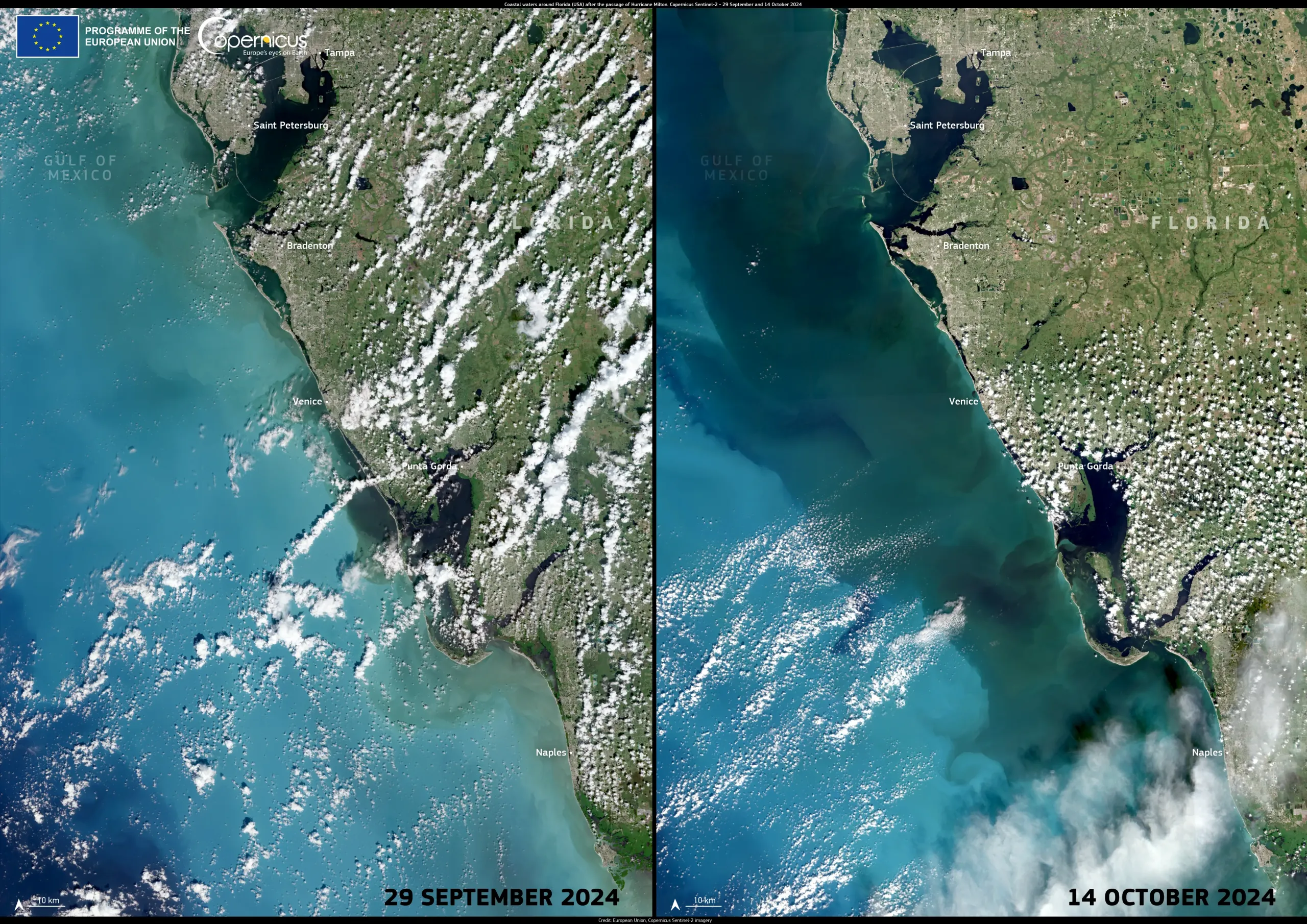
On 9 October 2024, Hurricane Milton struck the western coast of Florida, USA, bringing tornadoes, extreme wind, and torrential rainfall to the region. Milton was the third-fastest intensifying Atlantic hurricane on record, strengthening to a Category 5 storm in under 24 hours before decreasing to a Category 3 storm before making landfall.
A group of scientists studying the impacts of climate change on extreme weather say that Milton’s ferocity was exacerbated by global warming. Record high sea temperatures in the Gulf of Mexico contributed significantly to the hurricane's strength.
The effects of Hurricane Milton are visible in these Copernicus Sentinel-2 images comparing the west coast of Florida on 29 September and 14 October 2024. As a result of the storm’s rainfall, soil and sediment were transported to the mouths of rivers, which can be seen in the contrast between clear and darker water in the more recent image.
In the face of climate change, Copernicus open data allows researchers to better understand extreme weather events around the world while also providing authorities with information to mitigate their impacts on affected populations.
![Download [WEBP, 1.7 MB]](https://eu-space.europa.eu/sites/default/files/images/iotd/20241018_PostMilton.webp)