
OBSERVER: How the EU is building a common method to measure the environmental impact of space
The number of rocket launches is rising and the cost of reaching orbit is falling, drawing more satellites into an increasingly crowded space environment. That growth raises questions the space sector cannot yet answer: how much do space activities impact the environment, and how does the space sector measure environmental impact? The product environmental footprint category rules for the space sector (PEFCR4Space), a set of draft rules currently under development by the European Commission, sets out to build a standardised method for assessing environmental impact, which will be tailored to the specificities of the space industry. An open consultation of the first draft of the PEFCR4Space document invited space companies and interested stakeholders to provide comments and share their expertise. In this Observer, we look at the rules proposed in the draft document, at why space needs rules of its own, and at the way forward.
The cadence of orbital launches is increasing, and large satellite constellations are multiplying the number of objects sent to orbit, which puts more weight on the question: how much does all this activity impact the environment, and how can it be measured? European satellites can now track the planet's atmospheric condition with growing accuracy, yet the space sector behind that data has no agreed method for measuring its own footprint.
The PEFCR4Space, a draft setting forth a standardised method for measuring the environmental footprint of space-based products and services, is the attempt to build one common framework. The PEFCR4space is based on the EU’s Product Environmental Footprint (PEF) method and recommended approach for life-cycle assessments. The project’s coordinating partner, VITO, notes that there are currently no common space-sector-specific rules for life-cycle-based assessment shared by all actors along the value chain.
What PEFCR4Space sets out to do
The Product Environmental Footprint Category Rules (PEFCR) for the space sector will establish a standardised method for assessing environmental impacts across the EU space sector. These are sector-specific rules built on the European Union's Environmental Footprint Methods, and they set out exactly how to calculate and communicate the life-cycle impact of a product category, so comparisons between the products and services of different companies can be made on equal terms. Comparing sustainability claims is only possible once everyone measures impact in the same way; without a shared method, greenwashing is difficult to challenge, and real improvements are difficult to prove.
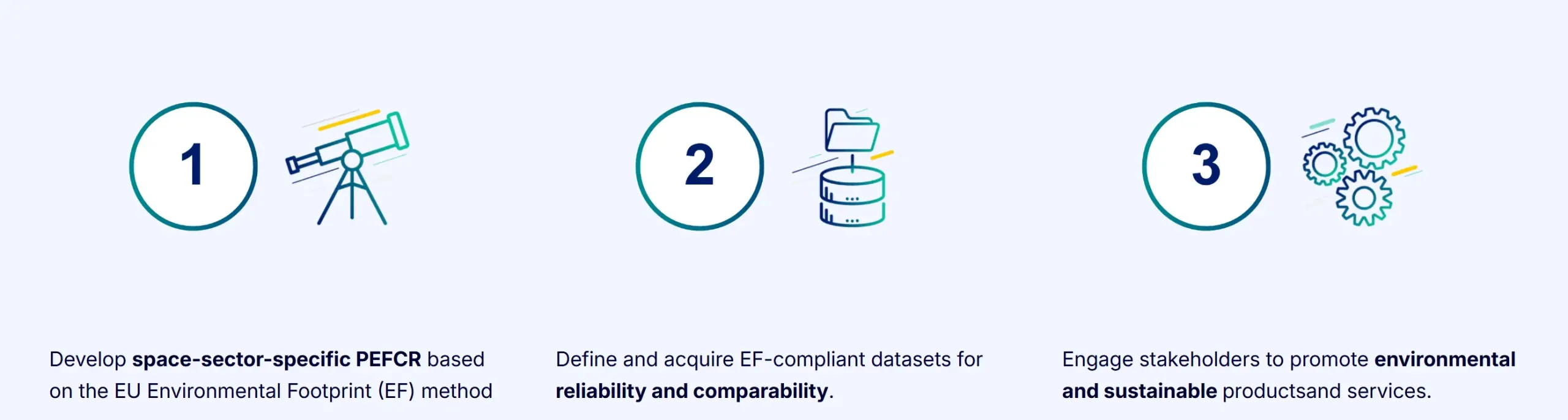
The initiative is mandated by the European Commission, and the first draft was prepared by a Technical Secretariat, a multi-stakeholder group drawing on industry, non-governmental organisations (NGOs), scientists, and public bodies, supported by a team of contractors led by VITO with PRé Sustainability, NovaSpace, Ecomatters, Ecoinnovazione, and Glasgow Caledonian University.
The first draft defines the scope of the rules: the space-based services delivered to stakeholders in the EU, together with the system boundaries for each stage of a service's life cycle. The unit of assessment is the service delivered, not the satellite itself. The assessment spans five life cycle stages: raw material acquisition and pre-processing, manufacturing, distribution, use, and end of life.
The rules work on two levels, with horizontal rules applying across space-based activities in a broad context and vertical rules covering six sub-categories of space activities, each with its own assessment rules: Earth Observation services, position, navigation, and timing (PNT) services, satellite video services, satellite connectivity services, in-space transport services, and uncrewed launch services from Earth to space.
Why space needs its own rules for environmental sustainability
Standard environmental accounting was not designed with the space sector’s specificities in mind. Supply chains are long and international, materials are highly specialised, lead times run into years, and much of the underlying data is commercially or strategically sensitive.
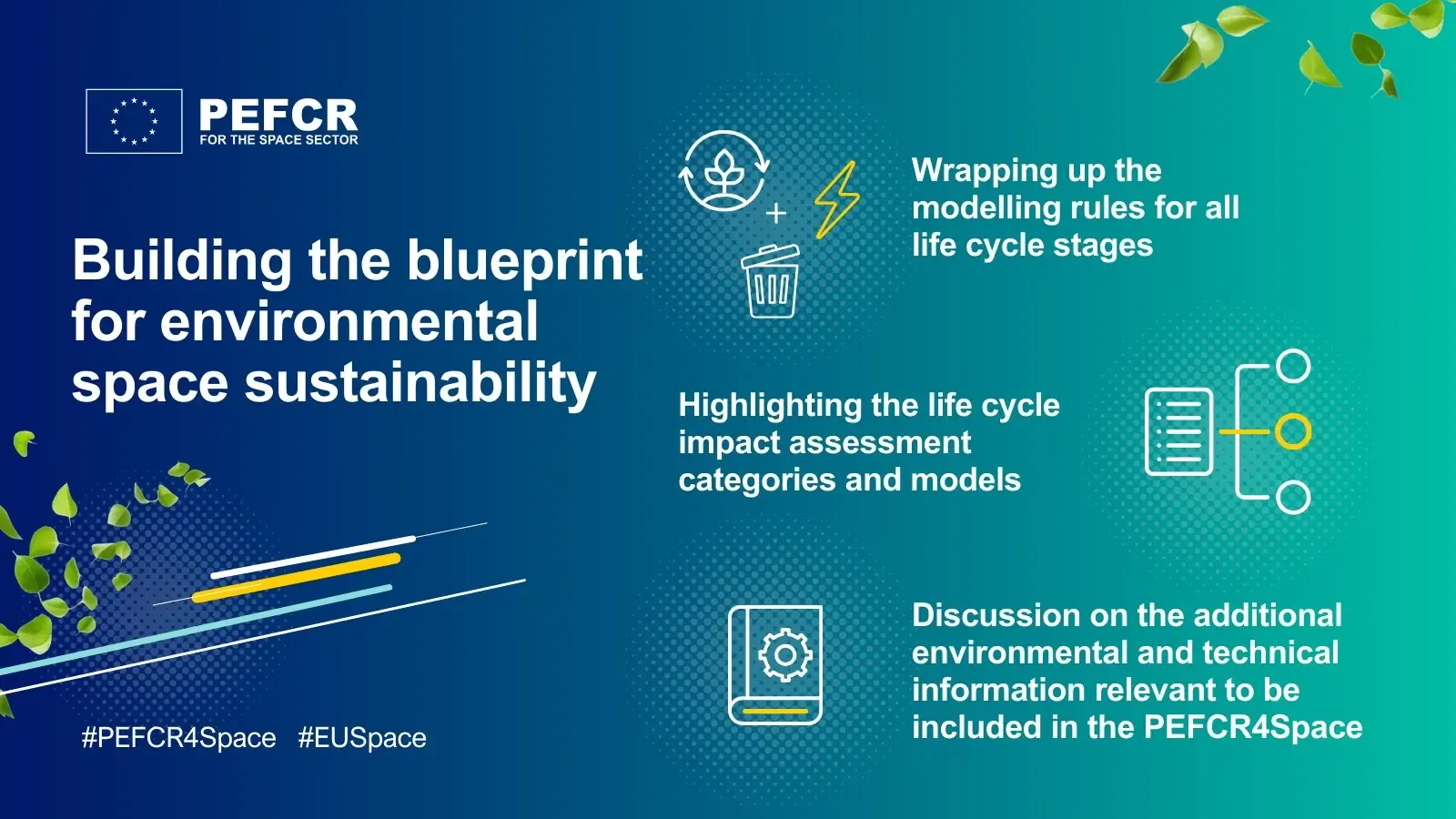
Conventional life-cycle assessment methods were not built to capture what takes place when a rocket burns through the upper atmosphere or a satellite breaks apart on re-entry. The first draft of the PEFCR4Space highlights that the impacts from these high-altitude events are not covered by standard assessment models, and it flags emissions such as aluminium oxide, black carbon, hydrochloric acid, and nitrogen oxides, along with their possible effects on climate and the ozone layer, as gaps the method cannot yet fully account for. This is an area of work which is still under scientific research. To close the gaps, the draft recommends developing new tools and including dedicated stratospheric emission categories, in a future update.
The PEFCR4Space is a game changer for the space sector. Curious to know more?
A transparent first draft
The first draft is candid about its own limitations. It is explicit about the datasets which do not yet exist and about the points at which proxy values stand in for primary measurements. Limited data is a particular challenge for modelling market average services. For Earth Observation, for instance, no representative product or benchmark could be defined, as its products are too diverse for a single one to represent the category; instead, two case studies were conducted, the Copernicus Anthropogenic Carbon Dioxide Monitoring (CO2M) and Altius missions. A method for measuring environmental performance earns trust by being honest about its own limits, and the draft was published for open consultation so that industry could provide feedback and help fill the gaps. That consultation ran from 15 October to 1 December 2025, and the feedback is now being worked into an evolved draft of the PEFCR.
In parallel, an independent external review panel of at least three third-party experts(NGO representatives, life-cycle assessment experts, industry experts) is reviewing the draft PEFCR4Space document, and will soon review the datasets under development, to ensure accuracy and reliability.
From proposals to capability
The method is taking shape alongside a live policy debate. When the European Commission published its proposal for the EU Space Act on 25 June 2025, the text required operators to calculate the environmental footprint of their space activities, obtain certification from a technical body, and submit the calculation with their authorisation application, feeding a common environmental footprint database. Since then, the picture has shifted. In a 2026 compromise text, the Council simplified the environmental sustainability chapter and removed both the environmental footprint declaration and the voluntary Union space label. The legislation is still under negotiation, with its final wording not yet settled.
A shared method will support comparable claims, help counter greenwashing, and support access to sustainable financing and public procurement. This method will guide the design of cleaner space systems from the outset and throughout the entire life cycle.
The next milestones are already in view. A dry run with the PEFCR4Space supporting studies is ongoing, gathering primary data from companies across the six sub-categories mentioned above. The practical methodological framework, elaborated in close collaboration with the PEFCR4Space Technical Secretariat, dedicated expert working groups, and committed stakeholders, is being tested in practice with selected partners. The dry run will be concluded by the end of 2026, and the results will feed into the process to further refine the draft rules ensuring that the PEFCR4Space framework is operational and that the methodology is robust, applicable, and scalable across the space sector.
A second consultation of the evolved draft is planned for 2027, ahead of the release of the final PEFCR4Space. Stakeholders are encouraged to contribute and help shape the PEFCR4Space framework.
For now, PEFCR4Space is a method in the making, helping the space sector become more sustainable by measuring its environmental impact and supporting its reduction.
Readers who want to follow the initiative’s progress can subscribe to the project newsletter for updates and can get in touch with the project team at pefcr4space@vito.be.