Craters dot the lava fields of El Pinacate in Mexico
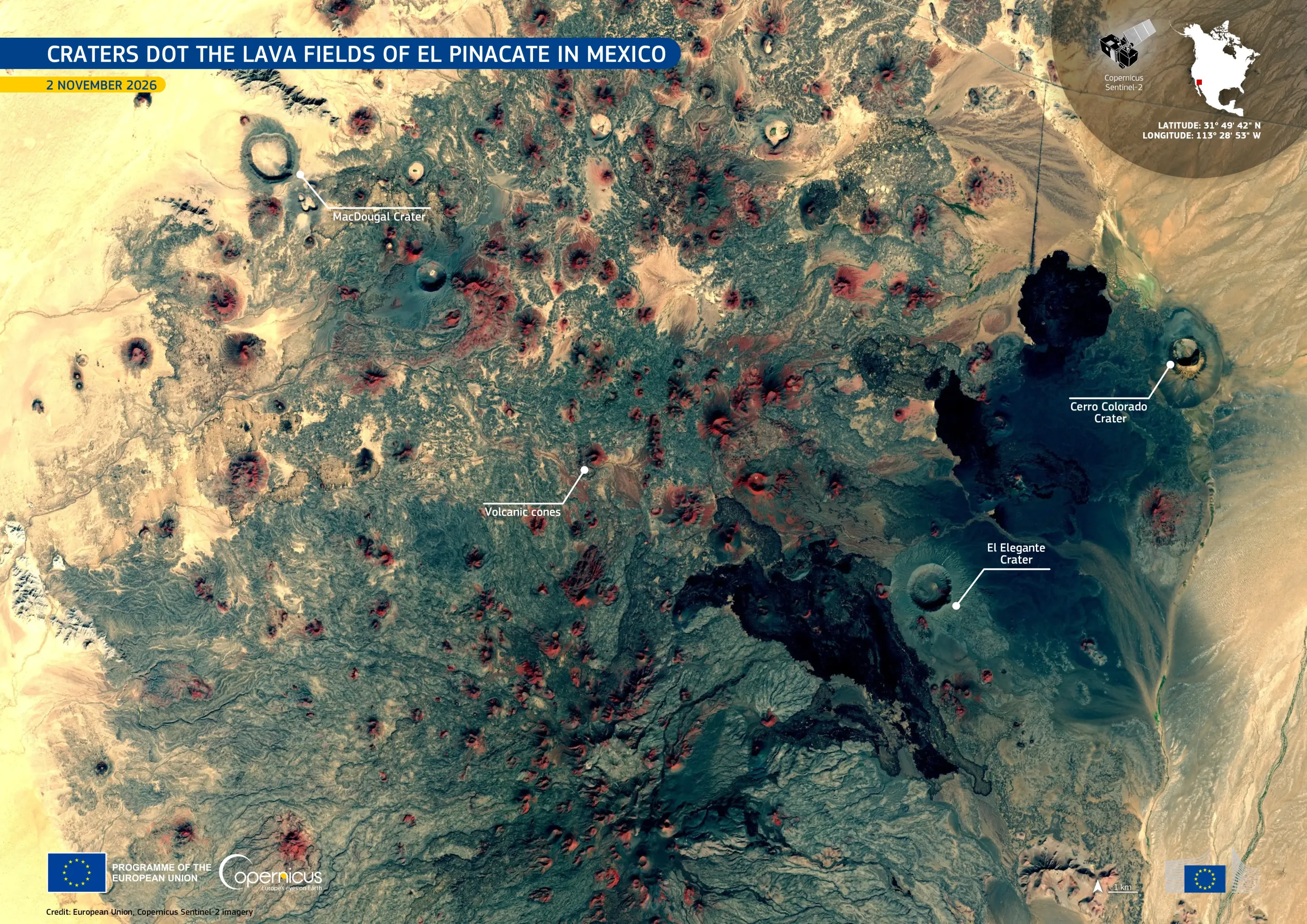
El Pinacate volcanic field forms part of a broad, gently sloping volcanic shield in the Sonoran Desert of north-western Mexico. Its surface features extensive basaltic lava flows, more than 400 cinder cones, and 10 large maar craters. Cinder cones form when fragments of lava ejected during an eruption pile up into small, steep hills. Maars form when rising magma meets groundwater, which turns to steam and triggers an explosion. The near-circular outlines of these craters are among the region’s most distinctive geological features. The area belongs to the El Pinacate and Gran Desierto de Altar Biosphere Reserve, which became a UNESCO World Heritage Site in 2013.
Acquired by one of the Copernicus Sentinel-2 satellites on 29 August 2026, this false coulour image shows the volcanic landscape in detail. Dark, irregular lava fields contrast with the paler surrounding desert, while circular craters such as MacDougal, El Elegante, and Cerro Colorado stand out through their sharply defined rims.
Copernicus Sentinel-2 data provide detailed information on land cover and surface features, supporting the monitoring and study of protected areas, geological formations, and desert environments.