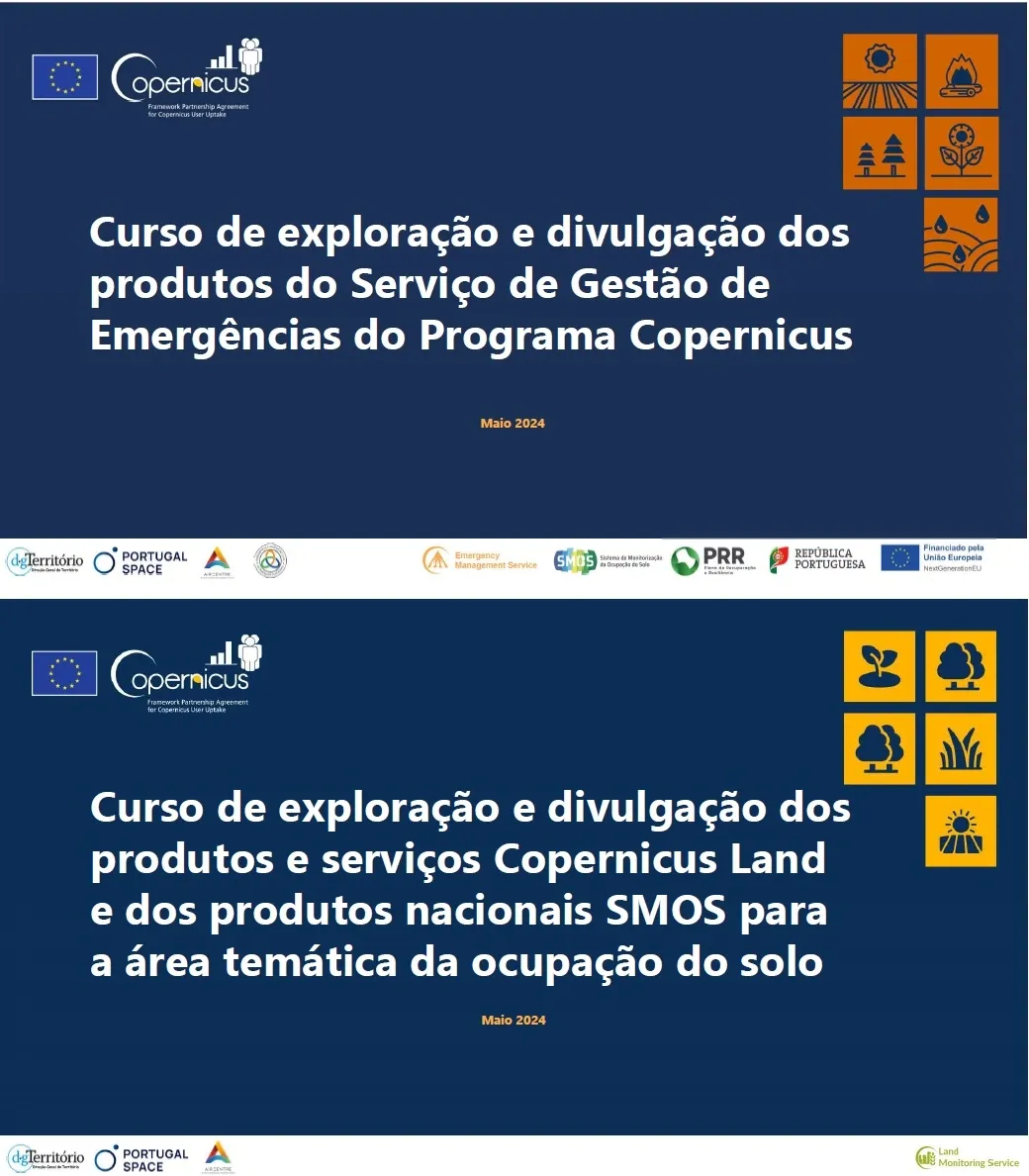
Training Courses organized by DGT
The events organized by DGT include two advanced training courses related to Sentinel-1 and Sentinel-2 processing and two training courses to explore and uptake the products of two Copernicus services, the Copernicus Land Monitoring Service (CLMS) and the Copernicus Emergency Management Service (CEMS). The respective events were held in online format and took place on the following dates:
- Advanced training course on Sentinel-1 image processing – 9th and 10th May 2024
- Advanced training course on Sentinel-2 image processing - 9th and 10th May 2024
- Training Course to Explore and Uptake the Products of Copernicus Land Monitoring Service (CLMS) – 6th May 2024
- Training Course to Explore and Uptake the Products of Copernicus Emergency Management Service (CEMS) – 7th May 2024
The advanced training courses on Sentinel-1 and Sentinel-2 were combined in the same event for logistical ease reasons and to allow the use of the two sources of information together, for example in image classification applications. Technicians from the central public administration with a potential interest to use satellite images from the Copernicus programme in their workflows were identified. The public institutes identified are related to the thematic areas of the environment, statistics, forestry, agriculture and civil protection. The course was held in Portuguese.
The course was organised in collaboration with the Faculty of Sciences of the University of Lisbon (FCUL), being led by experts in Remote Sensing. It consisted in theoretical but mostly of practical sessions. The topics covered were multispectral and microwave remote sensing and image classification with machine learning using combined Sentinel-1 and Sentinel-2 data. Open software was used, in particular QGIS and SNAP (Sentinel Application Platform) from the ESA.
The audience the CLMS and CEMS training courses was selected from an existing working group for the public administration related to the national geographic information system (SNIG), involving intermunicipal communities. Each intermunicipal community identified a group of technicians to attend each of the two training courses. Thus, the language adopted for the courses was Portuguese.
The CLMS training course aimed to train technicians to understand and use the land thematic products. Additionally, this course also included in a complementary manner the DGT’s Land Cover Monitoring System for mainland Portugal (SMOS). The thematic accuracy assessment of CLMS products in Portugal and the complementarity between CLMS and SMOS was presented. A practical session with several exercises took place to demonstrate how to combine National and European products, in order to answer questions relevant to thematic areas such as forestry, agriculture and land use planning.
The CEMS training course aimed to publicise specific features of this emergency management service and the cartographic products produced during its activations. The course was organised in collaboration with the National Civil Protection Authority in Portugal (ANEPC). Portugal Space also participated with a general presentation on the Copernicus programme. Various examples of CEMS activations in Portugal were addressed, showing the importance of added-value geospatial information in disaster situations for spatial planning at municipal level, particularly for rehabilitation and recovery of the territory. The course’s practical component included demonstration on how to perform a CEMS activation and to use SMOS products to monitor the land cover evolution in emergency situations.
The advanced training course on Sentinel-1 and Sentinel-2 image processing had 22 participants. The CLMS training course held a number of 39 participants, while the CEMS course had a number of 33 participants. To evaluate the overall satisfaction a post-event anonymous questionnaire was submitted to the participants, resulting in a score on a scale of 1 to 5 values of 4.57, 4.42 and 4.38 for the Sentinel-1 Sentinel-2, Copernicus Land and Copernicus Emergency courses respectively.