
Technological Non-Dependence
Powering strategic autonomy in space
Ensuring access to critical space technologies is key to our economy, society and security. This is why bolstering space research activities in support of EU’s strategic autonomy is a key priority for the European Commission.
The European Commission is enhancing technological sovereignty through greater investment and cooperation.
Investment in key space technologies
Through the Horizon 2020 programme (2014-2020) and the EU Space Programme under the responsibility of DG DEFIS, the European Commission has invested more than €100 million to strengthen Europe's non-dependence on critical space technologies.
These investments support the maintenance, development and evolution of European space systems and components, for which no viable alternatives currently exist in the EU.
As geopolitical pressures are rising along with global competition for unrestricted access to technologies access, the European Commission has decided to increase investments via Horizon Europe (2021-2027). As of 2023, the Commission has allocated €20 million annually to reduce EU non-dependence in the area of critical space technologies. By the end of Horizon Europe in 2027, the Commission would have invested €120 million in directly managed development projects, responding to space EEE components and equipment crucial for EU non-dependence
Horizon Europe is the EU’s primary funding programme for research and innovation. One of its objectives is to enhance European industrial competitiveness and ensure strategic autonomy in the space sector.
Over the past decade, the European Union has taken significant strides towards enhancing its technological sovereignty in space.
Upcoming EU-funded space R&I call 2025
The 2025 call encompasses multiple topics outlining the areas in which development activities are to be undertaken, which are summarised here:
- RISC-V Microprocessors on 7nm
- Chip Scale Atomic Clocks
- Solar Cells
- Connectors
- Advanced packages
- Memories
Further details can be found in the Technical Guidance Document that support the call.
In the 2019 political guidelines, the European Commission President von der Leyen
underlined that “it is not too late for Europe to achieve technological sovereignty in some
critical technology areas”.
Long standing EU development activities in the area of space EEE components
Since 2014, the Commission has invested and implemented projects in the area of microelectronics and EEE components for space applications, for example with a focus on GaN (Gallium nitride) technologies, rad-hard Systems on Chips (SoC) and advanced high dissipative packages, among others.
This commitment supports the EU space industry in its ambition to remain competitive globally. At the same time, ensuring that the EU safeguards its strategic autonomy and non-dependence, while maintaining leading position in space technology, contributes to economic growth, scientific advancement, and wider societal benefits.
Notable examples of achieved results
Rad-Hard FPGA
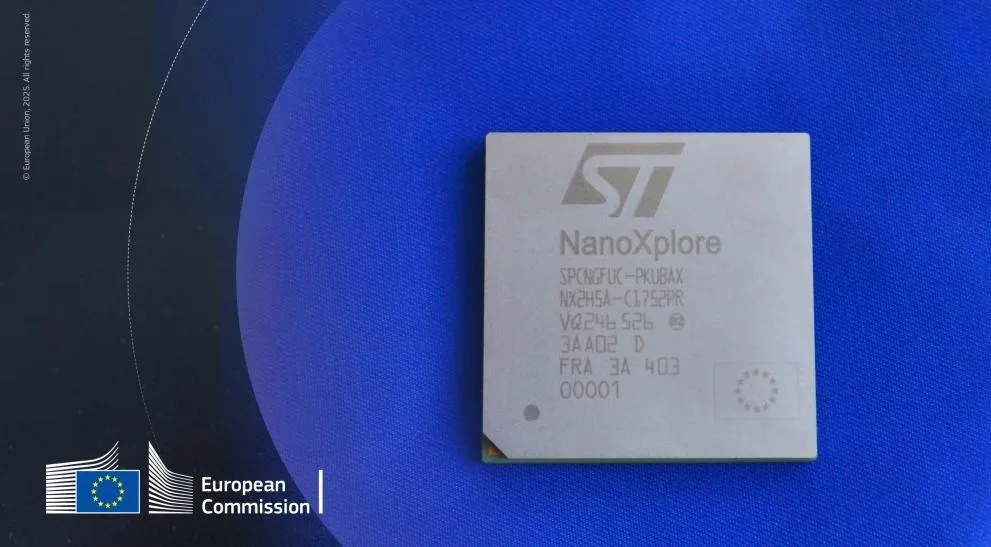
One major example of this investment is the funding of the first rad-hard space graded FPGA (Field Programmable Gate Array) entirely based on a European supply chain. This development has resulted in the creation of a series of 4 FPGAs products (NG-MEDIUM, LARGE, ULTRA and future ULTRA7) that have been developed or are currently under development through EU funding and development projects under direct management. These FPGAs are crucial components for all types of space missions, including Copernicus and Galileo, and are key enablers of future advanced on-board computing capabilities (e.g. autonomous systems).
Radiation hard ASICs and memories
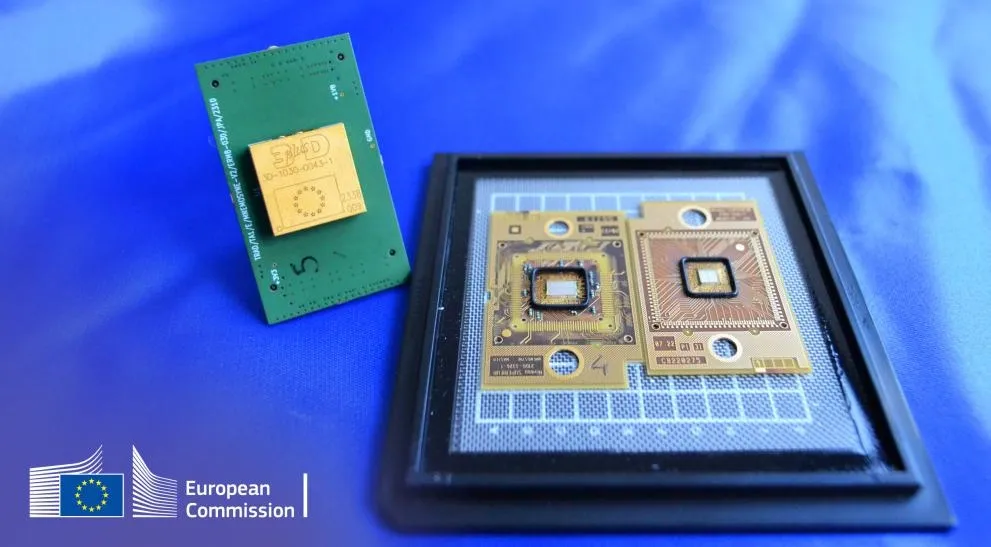
Another example is represented by the development activities aiming at design the foundational structures for radiation-hardened (by design) ASICs and a non-volatile memory (NVM) magnetic random-access memory (MRAM) based on 3D packaging using 22nm FD-SOI technology. These efforts focused on ensuring that next-generation satellite systems can securely store and boot critical software, even under intense radiation conditions. The MRAMs developed have demonstrated excellent performance and the commercialisation has already started.
GaN for RF and Power Applications
Wide bandgap semiconductors, such as gallium nitride (GaN), offer notable advantages for advanced space systems in terms of power density, thermal and radiation resilience. Recognising this, the European Commission has invested in GaN research for over a decade on projects and technologies, from 500nm (L-C Band) to sub-100nm (Q-Band), focused on space applications.
In parallel, activities have been carried out on GaN discrete processes for power applications. This is leading to the establishment of an EU-based capability for manufacturing radiation-hardened GaN devices, covering a range of voltage levels: low voltage (less than 100V), 200V, and 650V. Significant results have already been achieved for the less than 100V and 650V voltage ranges, while the 200V developments commenced in early 2025. The next step will be the industrialisation phase of these processes, which will enable the widespread adoption of GaN technology in space and other applications.

Radiation Test Facilities
DG DEFIS has also been investing into testing facilities relevant for space. One example is the current development of a very high-energy heavy ion (>1 GeV/n energy) irradiation facility in Europe. Benefitting of very high energy ions, the new test facility will enable the testing of complex electronics, such as Systems-in-Package and Systems-on-Chip, without the need to physically modify the components.

Cooperation with the European Space Agency and the European Defence Agency
In 2008, the Commission, ESA and EDA established a Joint Task Force (JTF) with the objective of ensuring autonomous and unrestricted access to these technologies. Since then, the JTF has mapped critical space dependencies and identified relevant actions.
In this context, the Commission, ESA and EDA have given a fresh impetus to the Joint Task Force to lift up their institutional cooperation in light of the recent geopolitical context. In July 2024, following a comprehensive process involving the European Commission, DG DEFIS, ESA, EDA and also the respective Member States and industry, two documents have been finalised. The 2024-2026 JTF Action List of Critical Space Technologies for European Strategic Non-Dependence and the 2024-2026 COM-EDA Action List of Critical Space Technologies for EU Strategic Non-Dependence.
Close cooperation is central to the success of European research and innovation. It enables alignment of efforts between EU institutions, agencies, Member States and industry. It strengthens the links between research, development and manufacturing, with positive impact on uptake of technology, market innovation and EU strategic autonomy in the field of space.
Through these efforts, the EU will be prepared to meet the challenges of the 21st century and maintain its competitiveness in the rapidly evolving global landscape.