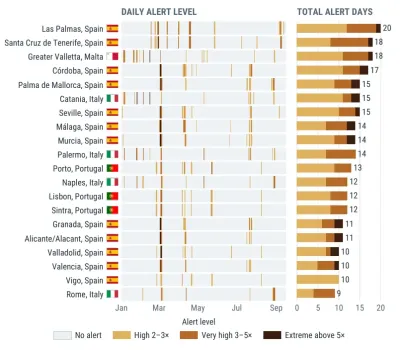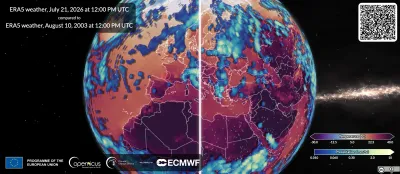
Recent intense wildfires, record-breaking heatwaves in Europe and high temperatures during the 2026 FIFA World Cup have drawn attention to the effects of extreme heat on public health and major…
Results (321)
The number of rocket launches is rising and the cost of reaching orbit is falling, drawing more satellites into an increasingly crowded space environment. That growth raises a question the space…
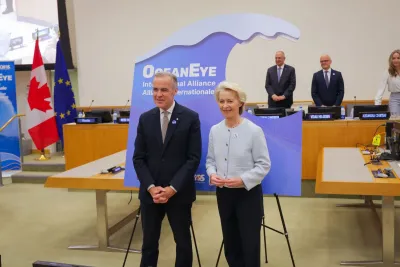
Every day, 8,000 floats, buoys, ships, and other platforms collect around 120,000 observations of the global ocean. On 23 September 2026, during the 81st United Nations General Assembly, the European…
Europe's space ambitions depend on a sovereign, resilient, and cost-effective route to orbit. At the second EU Access to Space conference, organised by the European Commission under the theme 'Ready…
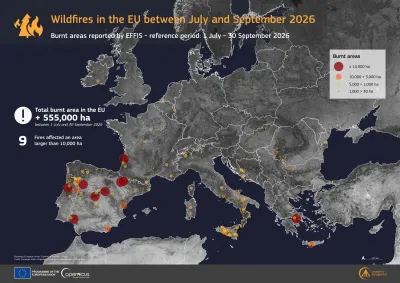
Europe’s 2026 wildfire season began early, after the warmest June on record in western Europe, and ran into September. The Copernicus Emergency Management Service (CEMS) supported preparedness and…
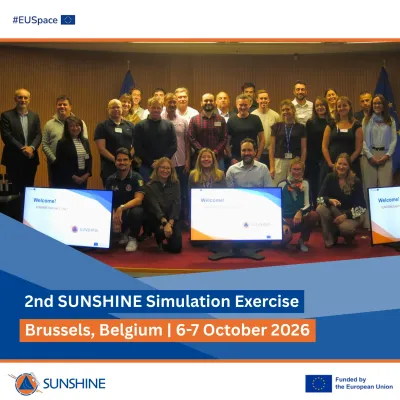
On 6 and 7 October 2026, the EU-funded SUNSHINE project conducted its second and final Simulation Exercise (SIMEX) in Brussels. The exercise gathered civil protection professionals from across the EU…
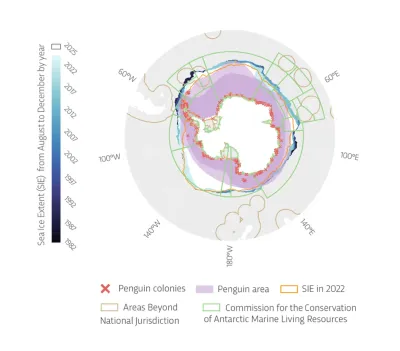
This year’s edition of the Copernicus Ocean State Report 10 (OSR10) highlights how ocean warming and extreme climate events are transforming the ocean at every scale. In this Observer we look at the…
Just two weeks after its launch aboard Vega-C, the Copernicus Sentinel-3C satellite has returned its first images and measurements of Earth, marking an important milestone for the EU’s Copernicus…
Today, the European Commission celebrates 10 years of EU Space Surveillance and Tracking (EU SST) operations, marking a major milestone for EU cooperation in space and a decade of concrete action to…
On 14 October 2026, the European Commission held the first cross-regional dialogue on space technologies and disaster risk management in Brussels, with regional disaster management bodies from Latin…
In 2016, 5 Member States pooled their national sensors with this objective. Today EU SST involves 19 Member States, helps protect more than 700 satellites, and serves more than 400 organisations…
As part of the Commission’s work on space weather, a new study has been published examining the potential impacts of an extreme space weather event on various sectors across the EU.
With the signature of the Grant Agreement extension, the EU SST Partnership and DG DEFIS concluded the onboarding of Belgium, Bulgaria, Lithuania and Luxembourg into the EU SST Partnership which now…
Building more efficient and affordable rocket engines with Horizon Europe-funded ENLIGHTEN project.
The EU and Canada have cooperated on space applications for decades. Today, they share Earth Observation (EO) data through Copernicus, and their data and services support the monitoring of Arctic sea…
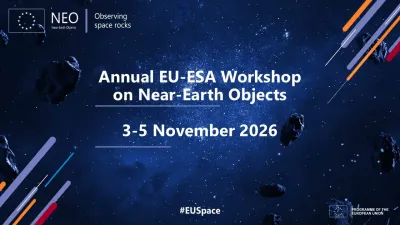
From 3 to 5 November 2026, DG DEFIS and ESA’s Planetary Defence Office hosted this year’s EU-ESA workshop on Near-Earth Objects in Petralia Sottana, Sicily.
Extreme heat, ground-level ozone, major wildfires, and long-range dust transport affected millions of people in 2026. The first CAMS Atmosphere Watch report, published on 30 September 2026, examines…
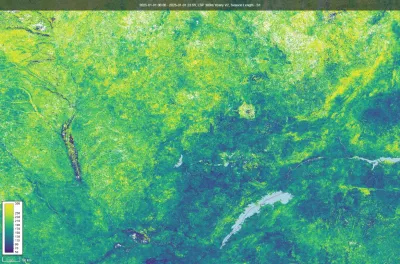
In this Observer, we look at how data from the Copernicus Land Monitoring Service support research into the connection between environmental change and human health, and why long-term observations…
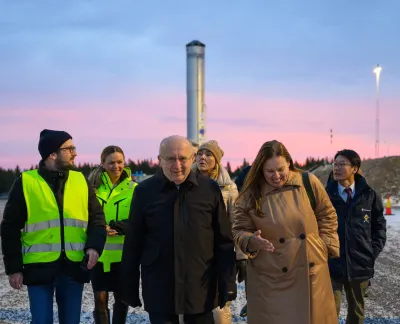
From the Swedish capital to the Arctic Circle, Commissioner for Space and Defence Andrius Kubilius took his ‘Launch Tour’ to Sweden on 5 and 6 November, putting EU’s access to space, security and…
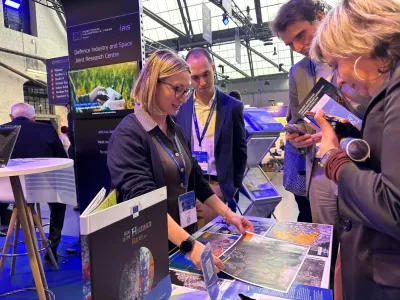
Wildfires, floods, and droughts are becoming more frequent and intense, while cascading and cross-border crises test Europe’s response capacity. The ninth European Civil Protection Forum, organised…
Showing 281-300 of 321 results