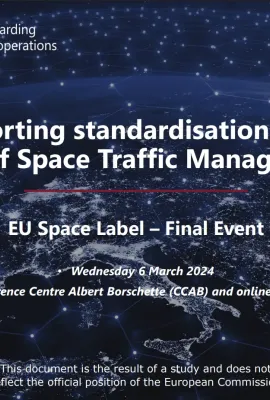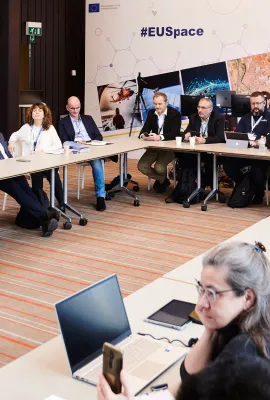
During this year’s EU Space Week from 7-9 November 2023 in Sevilla, Spain, DG DEFIS discussed the importance of space traffic management with the European space community.
Results (253)
Bringing Copernicus to Greece!
In past editions of the Observer, we've shared intriguing insights about Copernicus, perfect for introducing newcomers to the Earth Observation (EO) component of the European Union’s Space programme. We've shown you that Copernicus is the largest EO data provider, dove into the world of satellite "plane spotting," and even told the tale of how...
Let's introduce you the FPCUP WG Africa project!
The 1st issue of the FPCUP WG Africa Newsletter is being released!
The Copernicus Marine Environment Monitoring Service (CMEMS) has released an invitation to tender.
In an era in which understanding our planet and its dynamics is more critical than ever, the Geo-information Science and Earth Observation for Environmental Modelling and Management (GEM) Joint Master programme is nurturing the next generation of Earth Observation practitioners.
Survey on requirements and wishes for future soil products provided by the Copernicus Land Monitoring Service (CLMS).
Over the last twenty years, Europe has been hit with a series of record-breaking heatwaves and droughts. The summers of 2003 and 2010 were especially bad, with 2010 breaking a five-hundred-year European temperature record. Then, just eight years later in 2018, this record was broken again.
This is the reality of a boiling planet - These were the words of Ursula von der Leyen, during her State of the European Union address last month. Though this is hyperbole — as nowhere in the world are we close to boiling water temperatures — the President of the European Commission’s choice of words effectively captures the urgency of a...
On the 13th of September 2023, in the framework of the State of the Union, President von der Leyen presented Commission priorities for 2024.
Copernicus is the world's largest provider of Earth Observation data and has become a crucial resource for scientists, public authorities, entrepreneurs, journalists and citizens globally.
The way environmental problems and benefits are unevenly distributed across our societies paints a troubling picture of inequity. Typically, it's the low-income neighbourhoods that grapple with nearby hazardous waste sites, or indigenous populations that are negatively impacted by resource extraction operations such as logging, mining, and oil dril
Copernicus, the European Union's flagship Earth Observation programme, has been instrumental in providing essential insights which have been used to address a range of societal challenges.
Copernicus constitutes a key contribution to the objectives of the EU’s Strategy, including on polar matters. In fall 2021, the EU updated its Arctic Policy, for which Copernicus bears great support potential.
In 2021, the DG DEFIS and DG JRC, in coordination with the Copernicus Committee, User Forum and the entities implementing the Copernicus Security Services, joined efforts to enhance the streamlining of research and innovation based on user demand and operational requirements.
In the 19th century, many Europeans would have experienced an urban environment rife with poor sanitation, high pollution, few green spaces and rampant disease.
Innovative ideas of Polish students in the use of satellite data of the Copernicus Programme
Every day, Copernicus generates tens of TB of data through its constellation of Sentinel satellites and information services which are available on a free, full and open basis to anyone globally.
For decades, people in Europe and beyond have been preserved from famine and have enjoyed a wide variety of food. This did not happen by accident.
Showing 161-180 of 253 results