Copernicus provides accurate, timely, and easily accessible information to users around the world, improving the operations of emergency management services, deepening our understanding of climate change, helping us better manage natural resources and conserve biodiversity, and much more. Using a series of dedicated satellites, known as the...
Results (253)
Training and education to build a community of practice for the use of EO
The Copernicus satellite missions currently in orbit provide invaluable data that feed a vibrant ecosystem of Earth Observation products and services across diverse application areas. Copernicus is served by a set of six dedicated satellite families, the Sentinels, which are specifically designed to meet the needs of the Copernicus services and...
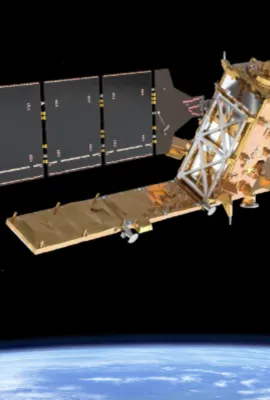
On 23 June 2015, the first Copernicus Sentinel-2 satellite was launched. It was the second Copernicus satellite sent to space, just a little over one year after the launch of Sentinel-1A. Copernicus’ first ‘colour-vision’ mission, Sentinel-2, aimed to improve our capabilities in monitoring land and vegetation cover as well as crop growth,...
CNES and ENSG (Ecole Nationale des Sciences Géographiques) recently provided technical training in interferometry for Vietnamese young researchers.
The Copernicus Land Monitoring Service (CLMS) had an exciting start to the month, celebrating its first General Assembly from June 3-5 in Antwerp, Belgium. This hybrid event brought together over 300 participants — including scientists, policymakers, and industry professionals — to shape the future of CLMS.
On 13 June 2024, DG DEFIS hosted the 6th meeting of the EU Industry and Start-ups Forum on Space Traffic Management (EISF).
Prepared jointly by Directorate Generals for Defence Industry and Space, Research and Innovation, and the European Commission’s Joint Research Centre (JRC), the Strategic Research and Innovation Agenda (SRIA) for Earth Observation outlines the future trajectory for Copernicus, the EU’s Space Programme’s Earth Observation component. By...
Challenge to enhance the Earth Observation community's ability to map and monitor the impact of human activities on the biosphere.
The European Union is paving the way towards adopting one of the world’s most ambitious air quality regulations. The revision of the Ambient Air Quality Directives is moving forward, and Member States will have to set strict monitoring and evaluation standards. The new Directives explicitly mention Copernicus, the Earth Observation component of...
We rarely think about the health of soils, maybe because they are always under our feet, while they are actually incredibly important to our way of life. They are the bedrock of agriculture, supporting growth and availability of crops and the livelihoods of farmers around the world. Soils are also full of life, holding a large amount of the...
Following the launch of the STM stakeholder mechanism in September last year, the STM main group, co-chaired by DG DEFIS and EEAS, were debriefed on latest activities on STM subgroups and learned about the recently concluded study for an EU Space Label
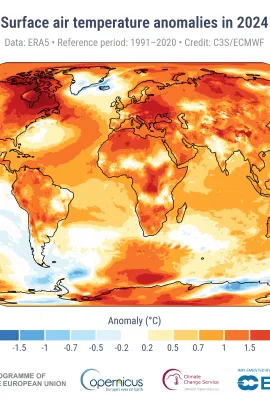
Since the 1980s, Europe has been warming twice as fast as the global average, becoming the fastest-warming continent. This is due to several factors, including the proportion of European land in the Arctic, which is the fastest-warming region on Earth. Europe’s fast warming is also caused by changes in atmospheric circulation which cause more...
With its first meeting on 16 May 2024, DG DEFIS and EEAS officially launched subgroup 1 of the STM stakeholder mechanism.
Space endeavours require innovation, and innovation thrives on diversity. Studies show that employees who feel that their organisation supports diversity, report an increase in their ability to innovate — up to 83%. Diverse teams challenge assumptions, break down barriers, and uncover solutions that may have eluded a more homogeneous group....
On 14-15 May 2024, DG DEFIS attended the ‘Management and Sustainability of Outer Space Activities’ conference organised by UNOOSA and the Portuguese Space Agency in Lisbon, Portugal.
Artificial Intelligence (AI) is not just a futuristic concept; it's a critical tool shaping the present, especially in the field of Earth Observation (EO). This is particularly evident in Copernicus, the Earth Observation component of the EU Space Programme, where, more and more, AI algorithms are employed to process the extensive data streams...
The DWD-Website on climate predictions has been updated with subseasonal and seasonal climate predictions of soil moisture.
As the saying goes, a picture is worth a thousand words, but in the world of Earth Observation (EO), it can be worth so much more. With the boom in EO satellite missions over the past few decades, and the open data deluge resulting from the full-scale deployment of the Copernicus Sentinel satellites and thematic services; the truth is that we...
Three workshops over the summer introduced end-users, researchers and students from the field of Cultural Heritage to Copernicus and satellite data.
Showing 101-120 of 253 results