
OBSERVER: FPCUP – Seven years of strengthening Copernicus uptake across Europe and beyond
Over the past seven years, the Caroline Herschel Framework Partnership Agreement (FPCUP) has strengthened the connection between the European Union’s Earth Observation programme and its user community. Through more than 220 actions carried out by 50 partners across 23 countries, it has supported the wider use of Copernicus data, encouraged innovation, and fostered lasting collaboration among national institutions. As the project comes to a close, its results highlight how coordinated European efforts can expand the benefits of space data for society. In this Observer, we revisit the FPCUP’s origins, outcomes, and contributions to the Copernicus ecosystem.
The European Commission launched the Caroline Herschel Framework Partnership Agreement on Copernicus User Uptake (FPCUP) in 2018 as a core instrument in its strategy to broaden the use of Copernicus data and services across Europe. Coordinated by DLR (the German Aerospace Center), the project was jointly funded, with the European Commission co-financing actions with national and regional partners.
Named in honour of astronomer Caroline Herschel, the initiative was intended to strengthen the Copernicus ecosystem by focusing on user uptake, that is, promoting not only the availability of data but its active use in real applications and services. The idea was for national and regional authorities, research organisations, SMEs, and other stakeholders to have a say in designing and deploying services tailored to their context and needs.
FPCUP sought to complement the existing user uptake instruments by operating at the community level and catalysing innovation. Over seven years, FPCUP served as a link between Copernicus data providers and the communities applying these data in policy, research, and services across Europe.
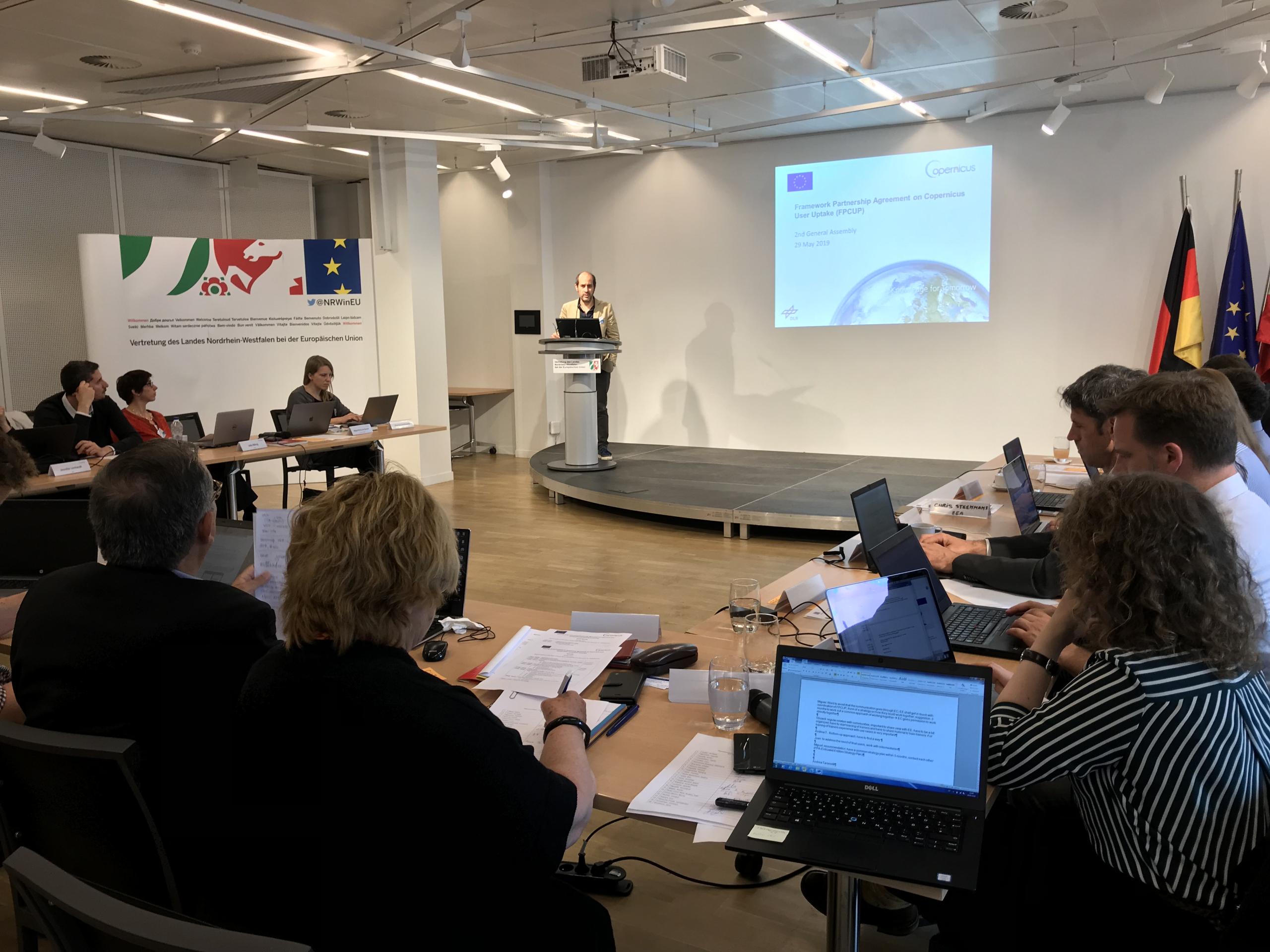
A bottom-up approach to building communities
A defining feature of FPCUP was its bottom-up model. Rather than prescribing a fixed set of projects, the programme invited its network of partners to propose actions grounded in end-user needs. This allowed for flexibility and responsiveness to local priorities.
This approach reflected the broader ethos of Copernicus, which has since day one been designed around user needs. From its inception, Copernicus has aimed to ensure that public authorities, researchers, and businesses can directly shape how satellite data are turned into usable information and services.
Across 23 European countries, 50 partner organisations ranging from national space or environmental agencies to universities, research institutes, and small businesses formed the backbone of the initiative. Their local knowledge guided project design and ensured that actions would resonate with regional challenges and institutional structures.
This diversity of participants helped foster cross-sectoral dialogue and capacity building. By privileging context-sensitive approaches, partner-led proposals could tap into existing relationships with target users and adjust to national or regional constraints, such as data availability, skills, or institutional mandates. Over time, these organically developed actions reinforced the user-driven approach of Copernicus by extending it to local and regional levels. They helped strengthen a pan-European Copernicus user community rooted in real needs.
Achievements across Europe
Over its lifetime, FPCUP funded more than 220 actions across thematic areas, including environmental monitoring, water management, disaster response, agriculture, land planning, and education. Through over 850 events and workshops, FPCUP reached around 25,000 participants, building awareness and technical capacity to use Copernicus data. Partners created more than 1,000 learning and communication resources in ten languages, expanding access to Copernicus information across national and linguistic boundaries. The programme also fostered international cooperation, launching more than two dozen cross-border projects that encouraged shared approaches to environmental and societal challenges, and extending its activities to Africa, Latin America, and Asia.
Actions ranged from pilot service development and training events to capacity-building workshops, awareness raising campaigns, application demonstrations, gap analyses, and user requirement studies. In the early years, actions were typically smaller in scale and nationally focused, reflecting modest budgets per project. Over time, however, an evolution toward larger, cross-border collaborations emerged, showing how FPCUP gradually grew into a European network for user uptake. Together, these efforts expanded the Copernicus user base, built trust among institutions, and empowered local decision-makers to develop tailored, lasting solutions.

Lessons from seven years of collaboration
After seven years of coordinated activity across Europe, several clear lessons have emerged from FPCUP. At its core, the initiative demonstrated that a bottom-up approach which allows national and local stakeholders to define their own needs leads to solutions that are both relevant and sustainable. By giving partners ownership over project design, FPCUP ensured that activities were anchored in real operational requirements rather than externally imposed priorities.
Another key insight is that collaboration multiplies impact. While the actions conducted at the national level proved to be effective, cross-border collaboration made the impact far-reaching. Yet, participants also noted that patience is essential. Building trust and demonstrating the value of Copernicus data to public authorities takes time. Sustainable user uptake depends not only on technical tools but also on relationships which develop over time.
FPCUP also reinforced the principle that co-development means creating products with end users, not for them. By involving practitioners throughout the process, from defining requirements to testing applications, partners produced tools and services better suited to their real-world contexts.
Finally, the programme’s flexible framework proved decisive for success. It allowed partners to adapt actions to national conditions and emerging priorities. The communities established under FPCUP now sustain this impact, maintaining the capacity and enthusiasm that the partnership helped to build across Europe.
Reflections and outcomes
On 1 October 2025, DG DEFIS and DLR hosted a concluding event in Brussels to mark the end of FPCUP. Stakeholders from across Europe gathered to present results, reflect on lessons from seven years of cooperation, and chart how the knowledge developed will continue to inform Copernicus outreach.
In his closing remarks, Mr. Mauro Facchini, Head of the Earth Observation Unit at DG DEFIS, highlighted the many achievements and positive spin-off effects of the partnership, including the creation of strong networks and communities of practice across Europe. He also noted that as seen from space through Copernicus data, the Union appears without internal borders, visually mirroring the cross-border nature of this collaboration.

Mr. Jens Danzeglocke, Earth Observation Focal Point at DLR, also underlined the importance of continuing to put Copernicus data and services to the full use and benefit of all Europeans.
To capture and catalogue the lessons learned from the past seven years, DLR, with input from DG DEFIS and contributions from participating partners, has developed a publication dedicated to FPCUP. The volume, Framework Partnership Agreement for Copernicus User Uptake: Highlights and Achievements, was distributed at the event and will be made available on the forthcoming EU Space Programme website, which will also host content from the FPCUP portal scheduled to close at the end of 2025.
Although the programme has officially come to an end, much of what it built remains. The network of European partners, together with international participants and sister institutions, continues to be active and committed to advancing Copernicus user uptake. The solutions, tools, and trust developed through their collaboration endure as practical results which support ongoing activities, leaving behind a proven and robust model for user uptake.