
OBSERVER: How the European Union is accelerating and reinforcing IRIS²
Secure communications underpin the European Union’s security, crisis response capabilities, and strategic autonomy. This is why IRIS², the European Union's Secure Connectivity Programme, was conceived. In response to growing user needs and geopolitical challenges, the European Union is accelerating the development and deployment of IRIS², upgrading the baseline constellation and expanding its capacity. A newly signed implementation agreement brings the first satellite launches forward to 2029 and expands the constellation to 348 satellites, enabling the early delivery of sovereign, secure, and accredited connectivity services from 2030 onwards. Additional capabilities have also been introduced, including dedicated capacity for defence, security, and emergency services. In this Observer, we look at how the planned constellation will be reinforced, and why these changes matter for Europe and its partners.
On 7 August 2026, the European Commission and the SpaceRISE consortium concluded negotiations which began in January 2026 and signed an implementation agreement to roll out Infrastructure for Resilience, Interconnectivity and Security by Satellite (IRIS²). The agreement expands the main constellation to 348 satellites and moves IRIS² from planning to full-scale deployment. It confirms the timetable for developing and deploying the satellites, procuring launch services, building the secure ground segment, and providing connectivity services.
The expanded constellation will comprise 330 satellites in higher Low Earth Orbit (LEO) and 18 in Medium Earth Orbit (MEO), launched in successive phases, with additional optional elements which can be deployed to support specific missions if required. The revised schedule brings the first launches forward to 2029 and enables the early delivery of sovereign, secure, and accredited European connectivity services soon after.
A constellation reinforced for defence and security
To respond to a changing security environment, the European Commission is expanding IRIS² governmental capacity beyond what was originally planned. To provide additional functionalities and stronger security, the design of satellites in the baseline constellation will be enhanced and an advanced set of 66 satellites in higher LEO will be added for defence, security, and emergency services.
Together, these changes will expand the secure communications available to governmental and defence users. The revised architecture will provide 60% more secure governmental capacity within the EU and 54% worldwide, significantly expanding Europe’s ability to support operations during crises. Defence and security applications are the primary drivers of these changes, although they also respond to a wider set of connected pressures linked to climate change and environmental degradation, which can disrupt livelihoods, intensify competition over resources, and contribute to displacement, migration, and instability. When these pressures lead to humanitarian or security crises, secure satellite communications can help governments and emergency services coordinate their response, including in areas where terrestrial networks are limited or disrupted.
This reinforced, faster-to-market constellation will give our Member States, emergency services, and citizens the resilient, autonomous connectivity they need now and in the crises of the future.
— Andrius Kubilius
Commissioner for Defence and Space
Extending coverage to the Arctic, remote regions, and Africa
IRIS² is designed to provide connectivity in areas in which terrestrial fibre and mobile networks are unreliable or unavailable. Its north–south orbits will extend coverage to some of the most demanding environments, including the Arctic. In these areas, dependable connectivity can support navigation, environmental monitoring, and emergency response. In the High North, sparse populations and limited ground infrastructure can restrict terrestrial connectivity. Satellite links can therefore provide an alternative when reliable terrestrial services are unavailable.
The same orbits will provide coverage across Africa, supporting cooperation between the European Union and the African Union. The two organisations already cooperate closely in space, building on years of joint work in Earth Observation and satellite navigation. In line with the Global Gateway Strategy, IRIS² could provide secure, high-speed connectivity in areas of Africa with limited terrestrial coverage. This connectivity could support sustainable development and improve digital links between the two continents. For remote communities in Europe and Africa, the system could support access to online education, telemedicine, as well as more reliable communications during emergencies.

Building on EU GOVSATCOM with a Team Europe approach
IRIS² builds on existing EU capabilities. Operational since January 2026, the European Union's Governmental Satellite Communications (EU GOVSATCOM) pools secure satellite capacity from several Member States and makes it available to authorised users across the European Union. EU GOVSATCOM provides an operational bridge to IRIS² by delivering secure communications while the IRIS² constellation is under construction. In the future, the GOVSATCOM Hub will also serve as the entry point for IRIS² governmental services.
Delivering a system of this scale requires a Team Europe approach which brings together the European Union, its Member States, and industry. Responsibility for IRIS² is shared across this partnership. The European Commission leads the programme and oversees its governance, while the European Space Agency (ESA) is responsible for the technical side, overseeing the system requirements and the design of the constellation. The satellites will be operated by the SpaceRISE consortium, made up of SES, Eutelsat, and HispaSat, three of Europe’s leading satellite operators, which bring extensive experience in operating satellites in LEO and MEO. The EU Agency for the Space Programme (EUSPA) will carry out the security accreditation of the system and oversee the provision of governmental services.
Under a public-private partnership, the IRIS² constellation will be built by a trusted European supply base, including Airbus Defence and Space, Thales Alenia Space, OHB, and Aerospacelab. The programme will also encourage participants from start-ups, small and medium-sized enterprises, and mid-caps to develop satellites with Internet of Things (IoT) and Direct-to-Device (D2D) capabilities. Authorised governmental users in EU Member States and participating countries, currently Norway and Iceland, will be able to communicate securely and without interruption during critical missions.

Supporting the European Union's Defence Readiness 2030 agenda
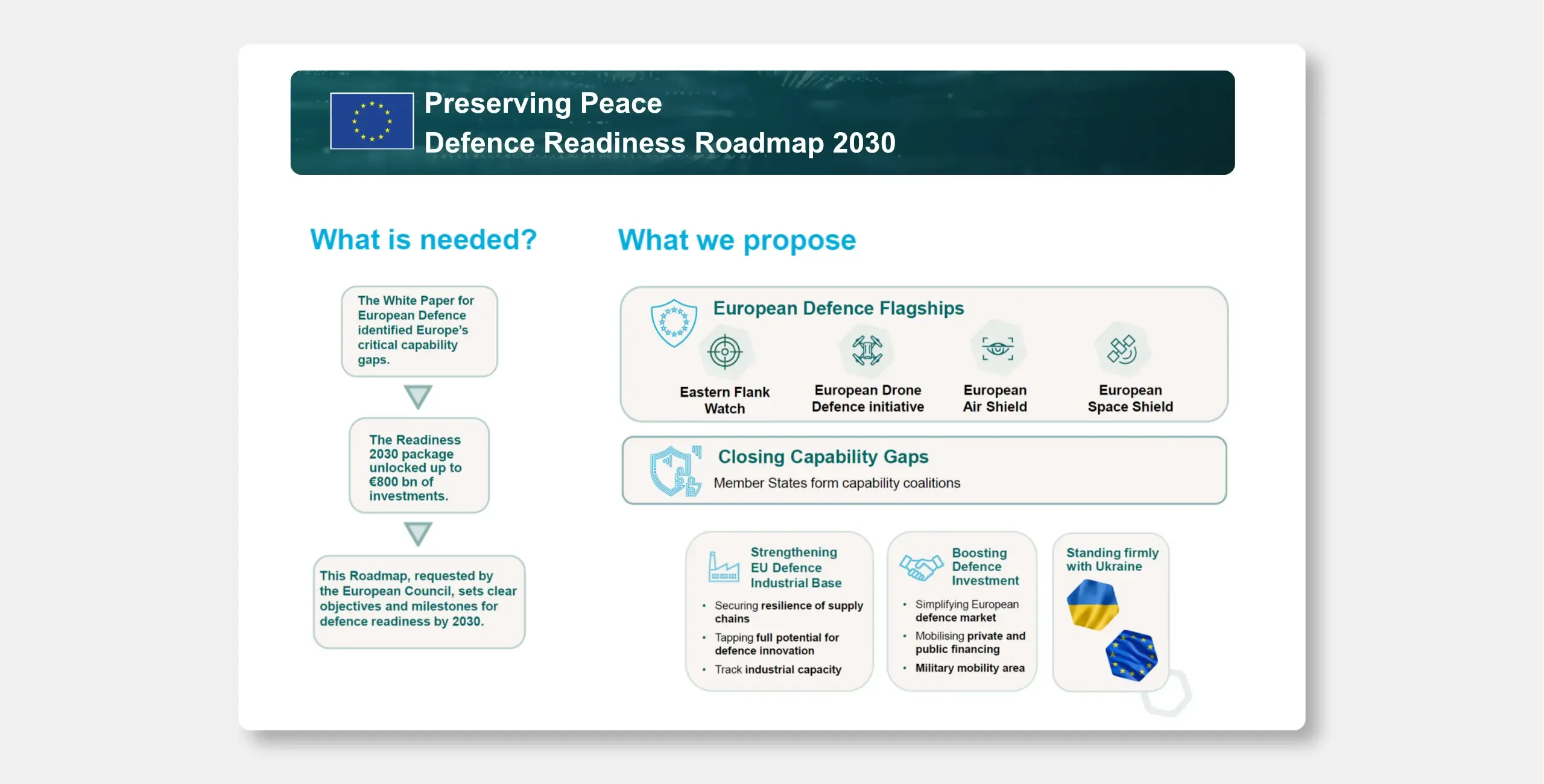
The timing of the IRIS² deployment aligns with the European Union's wider security agenda. In October 2025, the European Commission and the High Representative presented the Defence Readiness Roadmap 2030, titled ‘Preserving Peace’. The roadmap sets out clear objectives and milestones to achieve defence readiness by the end of the decade, building on the March 2025 White Paper for European Defence – Readiness 2030.
By accelerating the delivery of sovereign connectivity services, IRIS² will contribute to the EU’s 2030 readiness objective. European readiness depends in part on the ability of Member States to exchange sensitive operational information securely and maintain reliable communications during critical missions and crises. IRIS² will respond to these needs by enabling public authorities, defence organisations, and emergency services to coordinate decisions and operational responses through an infrastructure under European control, reducing dependence on non-EU systems for sensitive communications.
An additional €4 billion in programme funding supports the accelerated timetable, the increased capacity enabled by larger satellites, the additional launchers, the additional 66 satellites, and the improved onboard capabilities, while ensuring efficient use of existing programme resources. Funding will come from a combination of EU budget resources for 2028–2034 and further investment from Member States and third countries.
Three Member States are already backing IRIS² with national investments to meet specific additional needs. Hungary has committed €500 million, Poland €656 million, and Spain has announced an investment of between €1.6 billion and €2 billion. Further national contributions are under consideration, with the relevant agreements being finalised.
Further information on the architecture, services, and timetable, can be found in the IRIS² fact sheet and on the programme webpage.