
OBSERVER: With the launch of Sentinel-6B, Europe builds on its ocean monitoring legacy
Global sea levels continue to rise as Earth's climate changes. Coastal cities in Europe, from Rotterdam to Venice face increased flood risks, while small island nations remain among the most vulnerable to rising seas. Understanding exactly how fast seas are rising, and where, requires precise measurements from space and long time series.
Copernicus Sentinel-6 is the reference satellite mission for sea-surface-height measurements, ensuring continuity of the global ocean topography record which started in 1992. Sentinel-6 Michael Freilich (Sentinel-6A), launched in 2020, flies the long-established reference ground track, with a roughly 10-day repeat cycle, delivering centimetre-level sea-surface-height data together with significant wave height and wind-speed measurements.
Thanks to its state-of-the-art instruments, the satellite mission provides high-accuracy and stable measurements that serve as the benchmark for calibrating other satellite altimetry datasets, underpinning global mean sea level estimates and regional sea-level variability analyses.
The Copernicus Marine Service integrates Sentinel‑6 observations with those from other Copernicus Sentinel satellites and partner missions to produce operational oceanographic products and climate data records, providing downstream analyses and forecasts used by public authorities, industry, and researchers worldwide. Among these are the Global Ocean Along Track Sea Surface Heights data, visualised below, which provides measurements of the ocean’s surface height along the satellite’s ground track. Additionally, Sentinel-6 observations feed into products measuring global wave height and specific Ocean Monitoring Indicators (OMIs) focused on sea level rise.
Scientists use Sentinel-6 observations to monitor the rate of global and regional sea-level rise, map ocean currents, and derive sea-state parameters such as significant wave height, supporting coastal risk assessment, maritime safety, and climate policy applications in Europe and beyond.
Sentinel-6B, scheduled for launch in November 2025, will ensure the continuity of these measurements, maintaining the accuracy and stability of the global sea-level record. With a nominal lifetime of around five and a half years, it will provide users across the world with reliable data through 2030.

Building on a 30-year sea-level record
The Copernicus Sentinel-6 satellite mission builds on three decades of heritage in satellite radar altimetry, tracing its roots to the TOPEX/Poseidon mission and the subsequent Jason-1, Jason-2, and Jason-3 satellites. Together, these satellites have provided an uninterrupted time series of sea-surface height measurements since 1992, forming the global benchmark for sea-level monitoring. By maintaining the same reference orbit and cross-calibration approach, Sentinel-6 extends the long-term sea-level record that supports efforts to monitor and model long-term ocean and climate trends. Sentinel-6 also draws on European expertise developed through the Copernicus Sentinel-3 satellite mission and other Copernicus Contributing Missions, which refined radar-altimetry techniques and demonstrated how to ensure consistent and comparable measurements across successive satellites.
Sentinel-6 Michael Freilich and Sentinel-6B will operate in the same Low Earth Orbit (LEO) at approximately 1,336 kilometres above Earth. They follow the same ground track as their Jason-series predecessors to ensure direct comparability of measurements.
The satellite's primary instrument, the Poseidon-4 radar altimeter, sends radar pulses toward Earth's surface. By measuring the time these pulses take to bounce back from the ocean, the instrument calculates sea-surface height with centimetre-level precision. The Advanced Microwave Radiometer for Climate (AMR-C) sensor works alongside the altimeter, providing corrections for water vapour in the atmosphere which can affect measurements.
The Poseidon-4 instrument introduced a new open-burst radar operation enabling simultaneous Synthetic Aperture Radar (SAR) and Low-Resolution Mode (LRM) measurements. This dual mode capability provides double the number of radar samples compared to Sentinel-3, improving measurement precision while avoiding the introduction of bias into the long-term sea-level record.
The satellite also carries a Global Navigation Satellite System Radio Occultation (GNSS-RO) instrument which derives vertical profiles of temperature and humidity by analysing GNSS signals as they travel through the Earth's atmosphere. This information supports global weather forecasting and long-term climate monitoring, extending the Sentinel-6 satellite mission’s contribution beyond ocean observation.
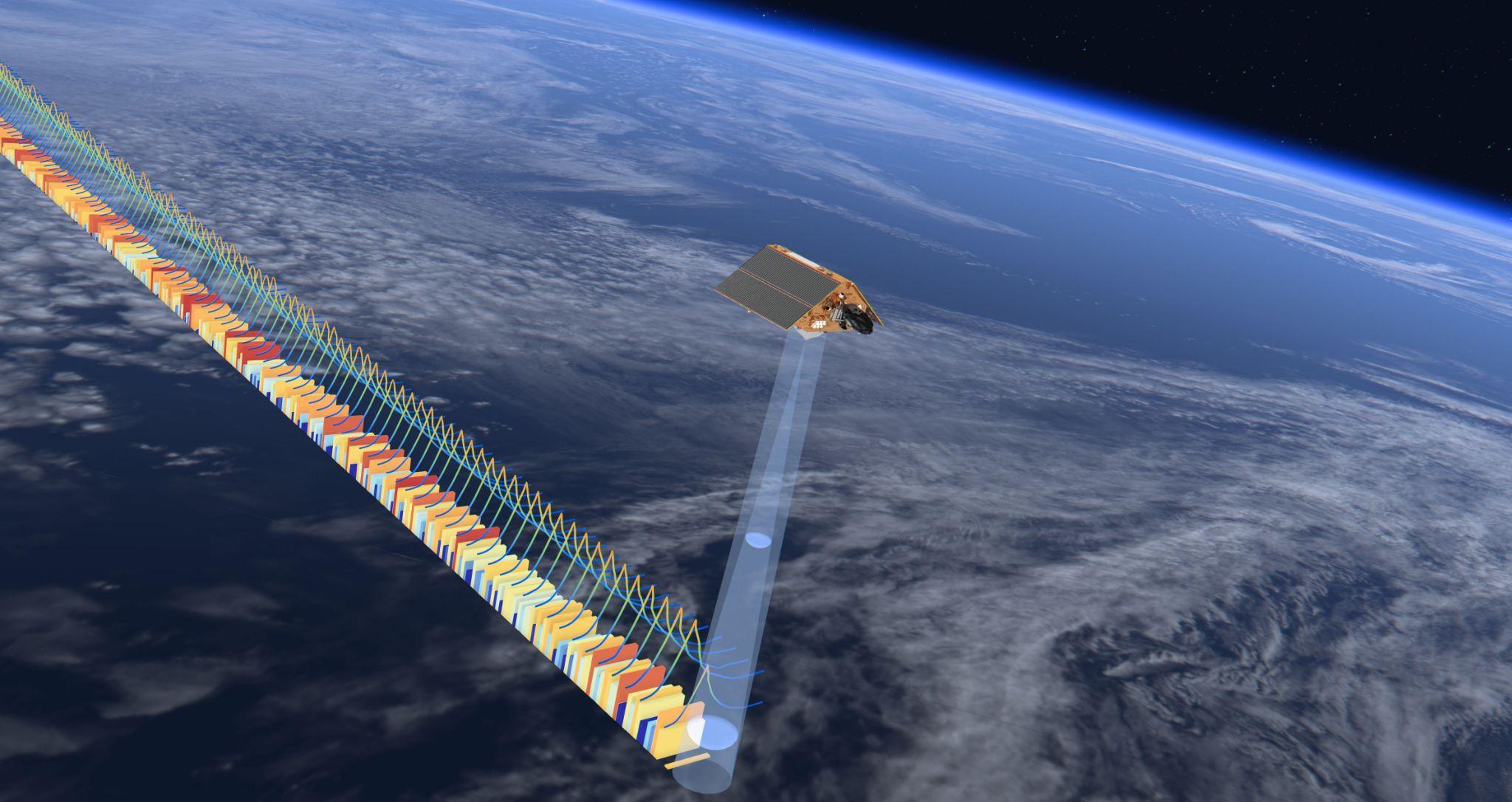
A seamless transition in orbit
Sentinel-6B will join its predecessor, Sentinel-6 Michael Freilich, in orbit for about a year to allow cross-calibration and a smooth transition between the two satellites. During this tandem phase, both satellites follow the same ground track at intervals of less than one minute, observing the same ocean zones nearly simultaneously. This configuration allows scientists to perform cross-calibration and precisely align the two datasets. This process ensures that the three-decade sea-level record remains consistent and scientifically valid when the new satellite replaces its predecessor.
Once the calibration phase is complete, Sentinel-6B will play a key role in securing the continuity of this Copernicus reference altimetry mission, ensuring the maintenance of a high-accuracy climate record through at least 2030. This transition is critical because even minor discontinuities in the data could distort the measured rate of global sea-level rise.
Sentinel-6 provides near-global (95%) ocean coverage at 66 degrees inclination, revisiting the same location every ten days. This consistent measurement schedule supports both operational oceanography and long-term climate research.
The measurements from the Sentinel-6 satellite mission have supported improvements of approximately 60% of Copernicus Marine Service’s ocean data catalogue, including sea-level rise indicators, ocean current analysis, and wave forecasting. Acting as the reference dataset for other altimetry missions, Sentinel-6 ensures that Copernicus ocean monitoring products remain accurate and comparable across decades. This extensive use across a myriad of maritime applications demonstrates the mission's and Europe’s central role in global EO capabilities.

European global leadership in Earth Observation
The launch of Sentinel-6B reflects Europe’s sustained commitment to EO and climate monitoring. Developed through partnership between the European Commission, the European Space Agency (ESA), the European Organisation for the Exploitation of Meteorological Satellites (EUMETSAT), and the US National Aeronautics and Space Administration (NASA), with contributions from National Oceanic and Atmospheric Administration (NOAA) and the French Space Agency (CNES), the mission exemplifies international cooperation in space science.
Airbus, serving as prime contractor, built both Sentinel-6 satellites, demonstrating European industrial capabilities in designing and operating complex space systems. Through the success of the Sentinel-6 satellite mission, Europe continues to support an innovative, growing, and robust space sector while delivering scientific and operational benefits to European citizens and international partners.
The satellite mission's data remain freely available to users worldwide as part of the European Commission's commitment to Copernicus’ open data access. Scientists, government agencies, and private sector users can easily and freely access Sentinel-6 measurements through the Copernicus Dataspace Ecosystem, WEkEO, and the EUMETSAT Datastore enabling applications ranging from climate research to maritime operations.
An unprecedented year for the EU Space Programme
In the past year, the EU Space Programme has undergone an exceptional period of Copernicus expansion. Following Sentinel-1C's successful launch in December 2024 and Sentinel-2C's entry into operational service in January 2025, the Programme has achieved an unprecedented pace of satellite deployments. Sentinel-1D is scheduled for launch on 4 November 2025, and will eventually succeed Sentinel-1A in its radar imaging mission. Sentinel-6B's launch later in November further reinforces Europe’s flagship Earth Observation space endeavours.
This rapid deployment schedule reflects both the growing maturity of the EU Space Programme and Europe’s sustained commitment to providing reliable satellite data for operational use. No other period has seen so many Copernicus satellites placed in orbit in such rapid succession, demonstrating Europe's growing capacity for complex space operations.
The successful launch cadence also ensures service continuity. As earlier satellites reach the end of their lifespans, new units seamlessly take over, maintaining the consistency of the long-term data streams which underpin the Copernicus Services. This continuity is what has made Copernicus a dependable foundation for European environmental monitoring and emergency response.
As Sentinel-6B begins its journey to orbit, it carries forward a thirty-year legacy of ocean measurements and maintains the precision and reliability established by its predecessor. This mission further exemplifies Europe’s commitment to scientific excellence, operational reliability, and open EO data access, serving users worldwide.