July 2026 was the second-warmest July on record in western Europe
The Copernicus Climate Change Service (C3S) has published its latest monthly Climate Bulletin, focusing on key climate trends in July 2026.
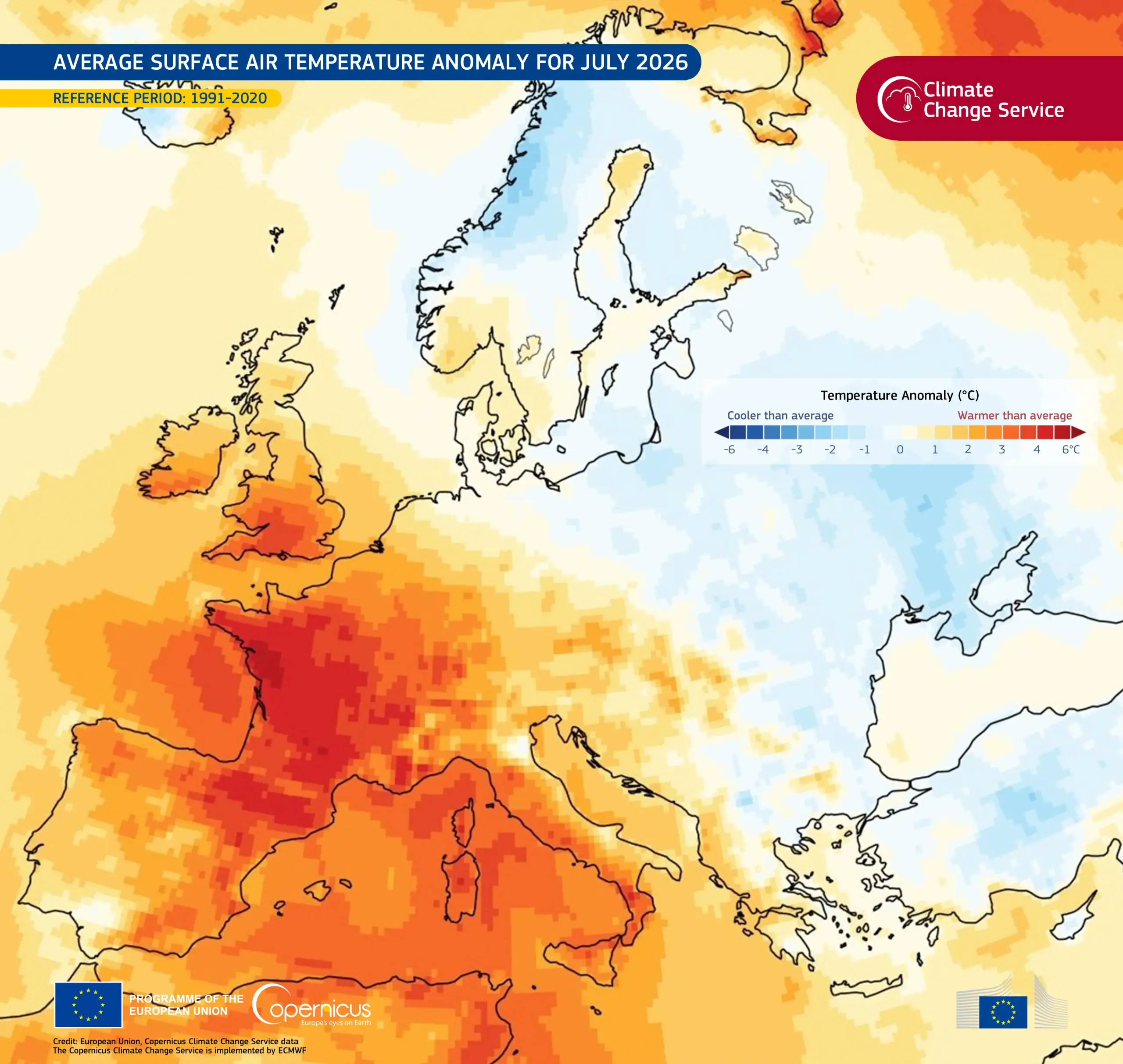
July 2026 was the second warmest July on record in western Europe*. The average surface air temperature across the region was 22.48°C, 2.53°C above the 1991–2020 average, only slightly below the record set in July 2006. Heatwave conditions affected the region during the first half of July and again towards the end of the month. France experienced its warmest July on record, with an anomaly of +3.8°C.
This data visualisation, produced using C3S data, shows the average surface air temperature anomalies across Europe in July 2026. A clear west-east contrast is visible, with temperatures well above average in the west and below average across much of the east and in parts of the Scandinavian Peninsula and Finland.
More information is available here.
*Western Europe is defined as land areas within 11°W–15°E and 37°–55°N.