
Algal bloom swirls across the western Baltic Sea
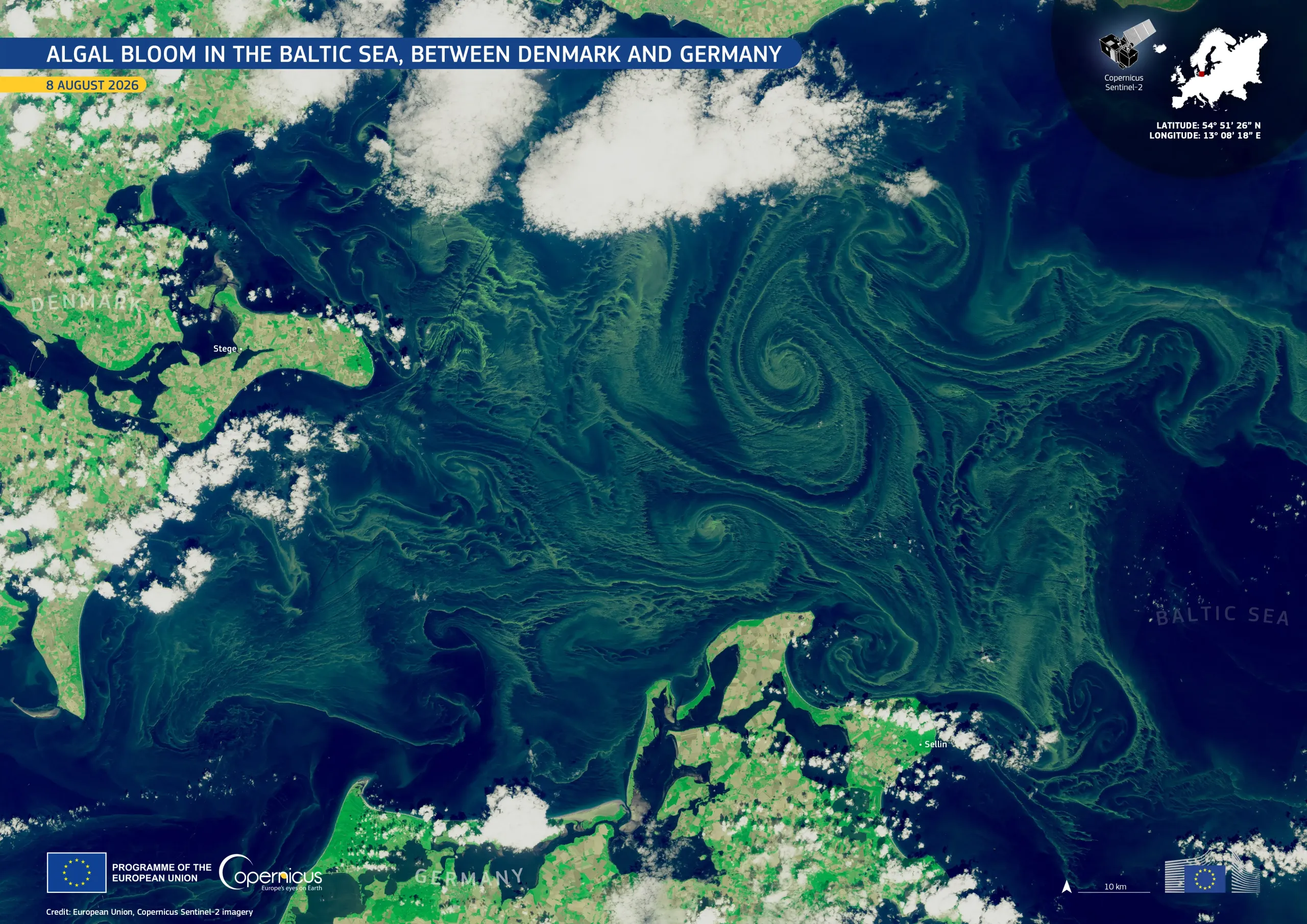
Cyanobacteria blooms return to the Baltic Sea every summer, when warm water, light winds, and nutrients carried in from land cause this type of algae to multiply. On 11 August, health authorities in Rostock, Germany, issued an alert for the presence of the algae along the coast and advised against bathing.
This image, acquired by one of the Copernicus Sentinel-2 satellites on 8 August 2026, shows the bloom developing in the Arkona Basin, between southern Sweden, the Danish island of Møn, and the German island of Rügen. Bright green filaments trace eddies tens of kilometres wide, drawn out by currents and wind, while darker blue water marks where the algae have not reached the surface.
Copernicus Sentinel-2 data support the monitoring of coastal water quality, contributing to eutrophication assessment under the EU Marine Strategy Framework Directive, the management of bathing sites, and marine ecosystem research.
![Download [WEBP, 1.36 MB]](https://eu-space.europa.eu/sites/default/files/2026-08/20260812_AlgalBloomBalticSea.webp)