After reaching the second-lowest extent on record in November 2025, sea ice extent in the Arctic remained unusually low into December. Data from the EUMETSAT Ocean and Sea Ice Satellite Application Facility (OSI SAF) show that, at the beginning of December 2025, Arctic sea ice extent was the lowest observed for this time of year. On 17...
Results (558)
Just weeks after its successful launch, Copernicus Sentinel-6B has delivered its first images, providing an early demonstration of how the mission will strengthen the global monitoring of oceans, coasts, and inland water bodies. Sentinel-6 is a collaborative EU–US mission, uniting the expertise of EUMETSAT, ESA, NASA, NOAA, and CNES to deliver...
On 9 December 2025, Storm Bram struck the United Kingdom and Ireland with strong winds and torrential rain, resulting in train, flight, and ferry cancellations, as well as power outages. On 10 December, flood warnings were in place across the United Kingdom, and severe flooding affected areas along multiple rivers. This image from one of the...
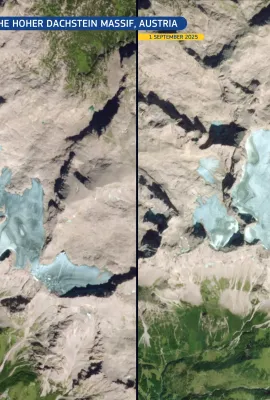
On International Mountain Day, we recognise the significance of mountain ranges and the crucial role that mountain regions play in the water cycle, primarily through the presence of glaciers. Glaciers are vast reserves of ice and snow distributed across the planet. They support ecosystems and communities, yet they are undergoing rapid and...
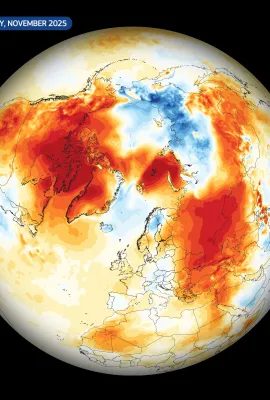
The Copernicus Climate Change Service (C3S) has published its latest monthly Climate Bulletin, which focuses on key climate trends in November 2025. The bulletin reports that November 2025 was the third-warmest November globally, with an average surface air temperature of 14.02°C, 0.65°C above the 1991-2020 average for the month. This data...
The Isle of Pines, which is part of the French overseas territory of New Caledonia, is renowned for its unique biodiversity and fragile ecosystems, including tropical forests and coastal wetlands. On 30 November 2025, a wildfire broke out on the island, spreading toward the town of Vao. The Copernicus Emergency Management Service (CEMS) was...
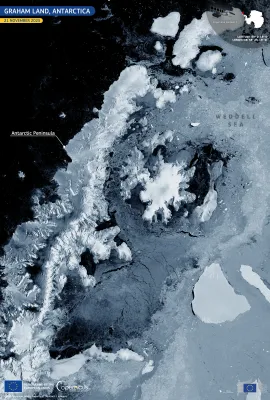
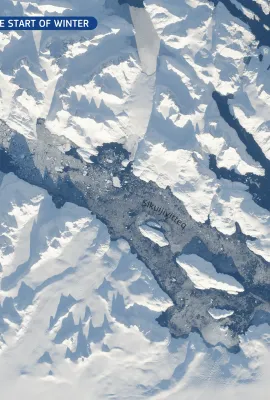
Graham Land, the northernmost stretch of the Antarctic Peninsula, is one of the most rapidly warming regions on Earth. Its mountainous spine and outlet glaciers drain into the Weddell Sea, forming an important transition zone between grounded ice, floating shelves, and open water. This dynamic landscape supports rich marine ecosystems,...
Early winter in north-western Africa is marked by the arrival of Atlantic weather systems that bring cooler air, increased cloud cover, and the first significant precipitation of the season. As these systems interact with the region’s varied terrain, they frequently produce episodes of heavy rain in lowland areas and snowfall across the...
Torrential rainfall associated with Cyclone Ditwah, which made landfall on Sri Lanka’s eastern coast on 28 November 2025, resulted in extensive flooding across the country. The event caused at least 410 casualties, with 336 people reported missing. The Copernicus Emergency Management Service (CEMS) was activated (EMSR851) to assess the extent...
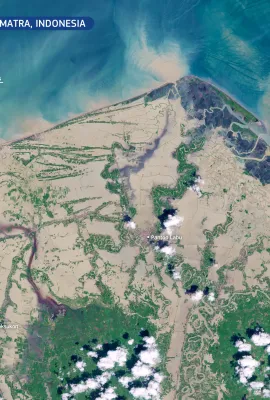
Cyclone Senyar formed during the night of 25-26 November 2025 in the Strait of Malacca, an area in which tropical cyclones had not been recorded for decades. The day after its formation, Senyar hit Indonesia, where it made landfall, causing flooding, landslides and more than 400 casualties in the north of the island of Sumatra. This image,...
On 23 November 2025, the Hayli Gubbi volcano in north-eastern Ethiopia erupted for the first time in recorded history. The volcano is located in the seismically active Afar Depression, part of the African Rift fault system. The event generated an ash and gas column reaching approximately 13–15 km, and the ash cloud spread over the Red Sea...
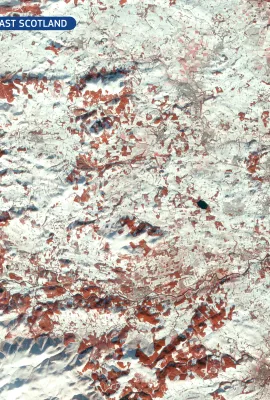
On 18 November 2025, the first major winter weather event of the 2025-26 season took place across parts of the United Kingdom, including north-east Scotland. Heavy snowfall blanketed large areas of the region, leading to travel disruption, the isolation of several rural communities, and the closure of numerous schools. Emergency services were...
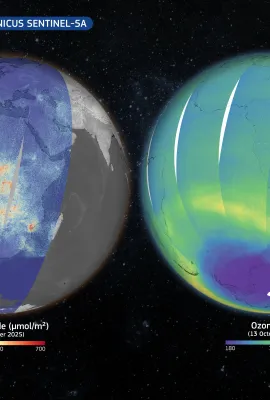
Copernicus Sentinel-5A has delivered its first images after its launch on 13 August 2025, marking a significant milestone in the monitoring of air quality from space. The Sentinel-5 mission provides observations of key air pollutants, essential climate variables, and stratospheric ozone, which is the protective layer shielding life on Earth...
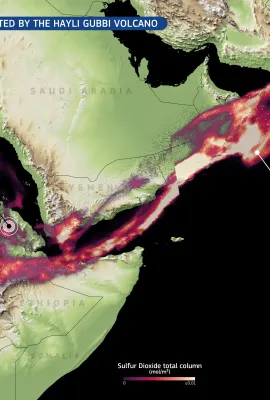
On 23 November 2025, the Hayli Gubbi volcano in Ethiopia, located approximately 800 kilometres north-east of Addis Ababa, erupted for the first time in nearly 12,000 years. As a result of the eruption, a large sulfur dioxide (SO₂) plume was emitted into the atmosphere. This image, derived from data acquired by the Copernicus Sentinel-5P...
As winter approaches in the Northern Hemisphere, reduced sunlight at high latitudes leads to colder temperatures and the formation of sea ice along the eastern coast of Greenland. This Copernicus Sentinel-2 image, acquired on 13 November 2025, shows the region illuminated in the soft light of a low sun, which creates elongated shadows across...
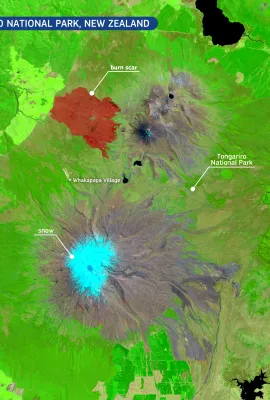
On 8 November 2025, a wildfire swept through nearly 3,000 hectares of alpine ecosystem in the Tongariro National Park, New Zealand. The fire damaged important habitats for native species on the North Island. Teams from the Department of Conservation, with support from Fire and Emergency New Zealand, fully contained the fire, and restoration...
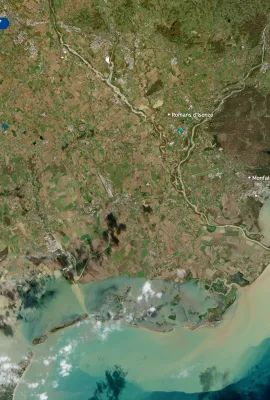
On 18 November 2025, intense flooding and a devastating landslide struck the Friuli Venezia Giulia region in northern Italy following prolonged, intense rainfall. The area surrounding the towns of Gorizia and Romans d’Isonzo were affected by significant inundation, with rivers overtopping their banks and submerging adjacent lowlands. This...
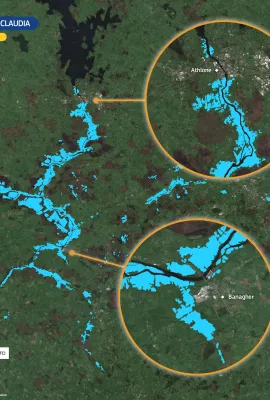
On 14 November 2025, Storm Claudia swept across Ireland, bringing severe weather conditions and significant flooding to the Leinster and Munster provinces. The Copernicus Emergency Management Service (CEMS) was activated (EMSR849) to assess the extent and impact of flooding in the affected regions. This data visualisation, obtained using the...
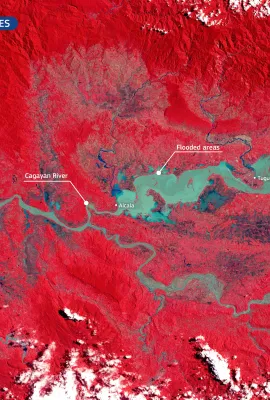
Following the landfall of Typhoon Fung-wong on 9 November 2025, northern regions of the Philippines were affected by extensive flooding, with the Cagayan Valley among the worst hit areas. The typhoon brought intense rainfall, causing the Cagayan River to overflow its banks, submerging agricultural land, infrastructure, and urban areas,...
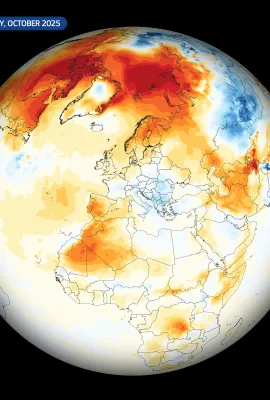
The Copernicus Climate Change Service (C3S) has published its latest monthly Climate Bulletin, which focuses on key climate trends in October 2025. The bulletin reports that October 2025 was the third-warmest October globally, with an average surface air temperature of 15.14°C, 0.70°C above the 1991-2020 average for the month. This data...
Showing 21-40 of 558 results