The Copernicus Climate Change Service (C3S) has published its latest monthly Climate Bulletin, focused on key climate trends in May 2025. The bulletin reports that May 2025 was the second warmest May on record globally, with an average surface air temperature of 15.79°C, 0.53°C above the 1991-2020 average for the month. In Europe, the average...
Results (558)
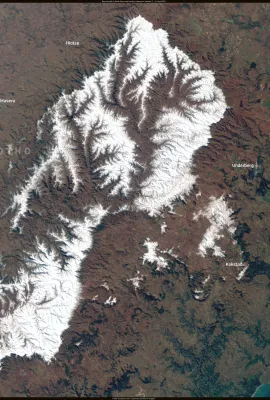
On 7 June 2025, a rare and intense low-pressure weather system affected parts of South Africa and Lesotho, bringing snow, heavy rainfall, and cold temperatures. The event caused widespread disruption to transportation infrastructure, prompting South African authorities to urge residents to avoid unnecessary travel. The storm further led to...
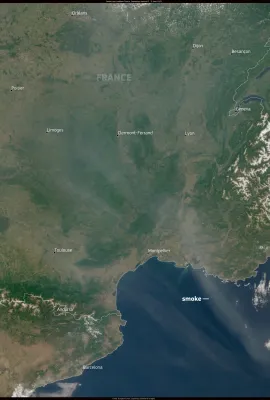
On 9 June 2025, a thin veil of smoke was observed drifting over several regions of France, including Normandy, Brittany, Occitanie, Auvergne–Rhône-Alpes, and Provence-Alpes-Côte d’Azur. The smoke, originating from the intense wildfires burning in Canada, was carried across the Atlantic and is visible in this Copernicus Sentinel-3 image acquired...
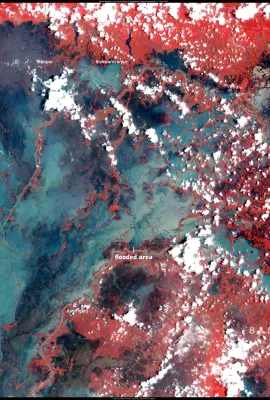
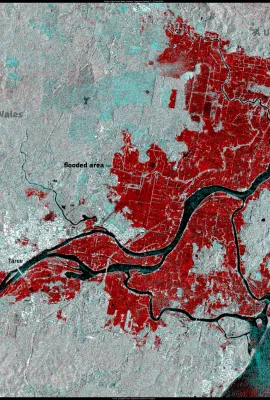
From late May to early June 2025, Sylhet and surrounding districts in northeastern Bangladesh were affected by extreme rainfall. Approximately 405 mm of rain fell within 24 hours on 1 June, making it one of the heaviest downpours of the season. This Copernicus Sentinel-2 image, acquired on 9 June 2025, shows extensive flooding across the...
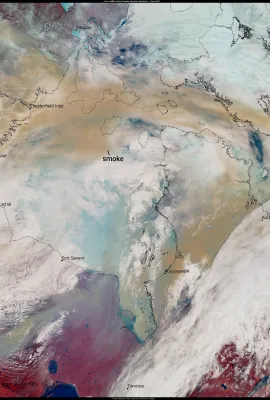
Since May 2025, dozens of intense wildfires have been burning across the Canadian provinces of Alberta, Manitoba, and Saskatchewan, affecting vast areas of the boreal forest and forcing the evacuation of thousands of residents. These fires have released large volumes of smoke into the atmosphere, severely degrading air quality and reducing...
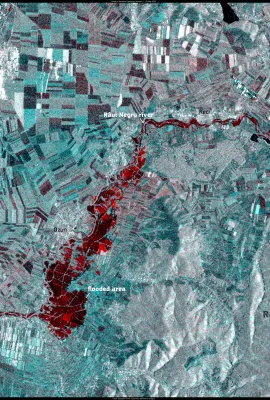
In late May 2025, parts of central and northern Romania were affected by severe flooding after days of heavy rainfall. 16 counties were impacted, prompting the evacuation of hundreds of people as streets and houses flooded. On 28 May, the Romanian Inspectorate General for Emergency Situations (IGSU) activated the Copernicus Emergency Management...
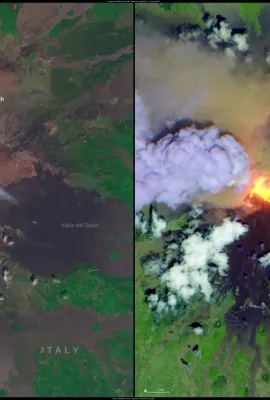
At 11:24 AM local time on 2 June 2025, Mount Etna, the most active volcano in Europe, produced a spectacular eruption, propelling a dense column of ash and smoke several kilometres into the atmosphere. The event was characterised by vigorous Strombolian activity, lava effusion, and a pyroclastic flow. According to Italy’s National Institute of...
Baa Atoll, located in the western part of the Maldives, comprises 75 islands, 13 of which are inhabited. Home to some of the most pristine coral reefs in the country, the atoll supports a wide variety of species, including manta rays, whale sharks, and sea turtles. Due to their ecological importance, several regions of the atoll were designated...
In May 2025, three days of extreme rainfall prompted major flooding in the Hunter and Mid North Coast regions of New South Wales, Australia’s most populous state. The state’s emergency services agency estimated that the flooding impacted at least 10,000 properties and led to at least five casualties. The flooding further isolated around 50,000...
On 14 May 2025, a vast forest fire struck the community of Lac du Bonnet, in the province of Manitoba, Canada, resulting in two casualties and prompting the evacuation of about 1,000 residents. Manitoba had been affected by unusually hot, dry, and windy conditions at the time of the fire. After four days, smoke from the fire reached the...
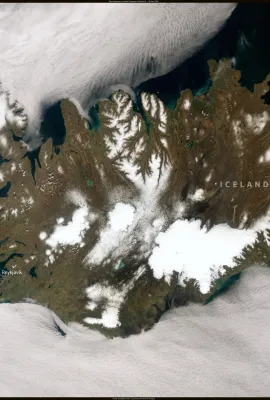
In mid-May 2025, a heatwave affected Iceland, setting records across the country. At Egilsstaðir Airport in eastern Iceland, temperatures reached 26.3°C, the highest ever recorded in May. This surpassed the previous May record of 25.6°C set in 1992. In Reykjavík, the capital, temperatures reached 19°C on 16 May, exceeding the city’s highest...
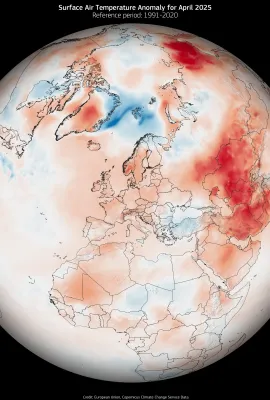
The Copernicus Climate Change Service (C3S) has published its latest monthly Climate Bulletin, focused on key climate trends in April 2025. The bulletin reports that April 2025 was the second warmest April on record globally, with an average surface air temperature of 14.96°C, 0.60°C above the 1991-2020 average for the month. Furthermore, April...
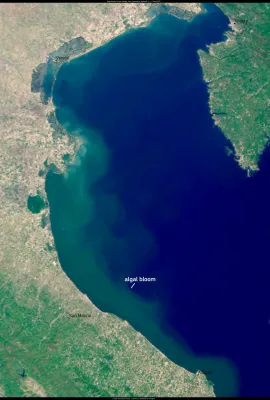
In early May 2025, the waters along the coast of the central and northern Adriatic Sea were affected by an algal bloom. The proliferation of the algae, which turned the seawater a noticeable green, was probably driven by higher-than-average sea temperatures and recent heavy precipitation, which increased river runoff into the sea. The bloom...
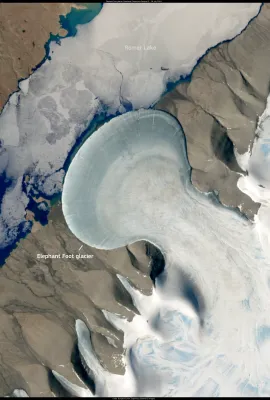
Elephant Foot Glacier, located on the Kronprins Christian Land peninsula in northeastern Greenland, is a striking piedmont glacier which flows into Romer Lake. With a terminal lobe measuring 5.4 kilometres in width, the glacier forms a distinctive circular fan of ice as it spreads from a central outlet. The glacier and lake are visible in...
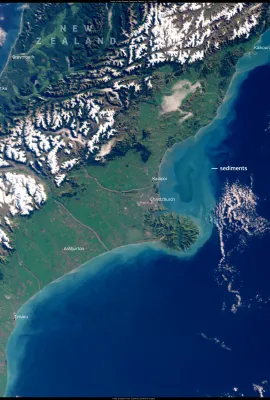
In late April 2025, a rapidly deepening area of low pressure in the Tasman Sea triggered flooding and severe weather across New Zealand, prompting a red warning from the national MetService and a state of emergency to be issued in Christchurch. In some regions, more than 100 mm of rain fell in under 12 hours, leading to burst riverbanks and...
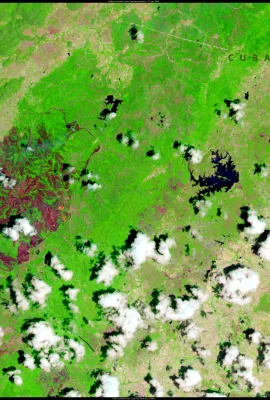
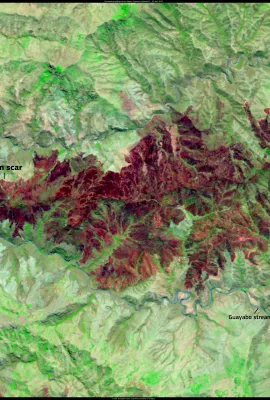
4 May is the International Firefighters’ Day, dedicated to recognising the essential work of firefighters in ensuring that their communities and environments are as safe as possible. An example of this important work can be found in Cuba, where firefighters brought a massive wildfire in the province of Pinar del Río under control nine days...
Since the beginning of 2025, Mexico has been affected by a series of severe forest fires. According to the National Forestry Commission, over 2,800 forest fires have been recorded since January, across all of the country’s states. The fires have burnt over 215,000 hectares of land, making 2025 the third most severe year on record in terms of...
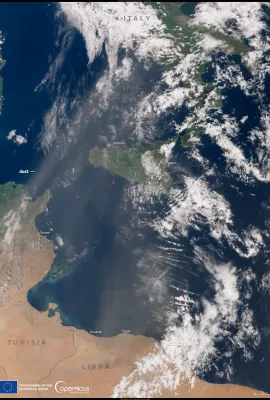
In mid-April 2025, a combination of meteorological phenomena began to affect Italy, as Sirocco winds transported large quantities of Saharan dust across the Mediterranean. This event led to hazy skies and a distinct yellowish tint over southern regions and the major islands, particularly Sicily. This Copernicus Sentinel-3 image, acquired on...
The Copernicus Climate Change Service (C3S) released the ‘European State of the Climate 2024 Report’ on 15 April 2025, delivering key insights on the state of Europe’s climate in the previous year. One of the key findings is that during the 2023–2024 hydrological year, glaciers across all European regions were affected by ice loss. In the Alps,...
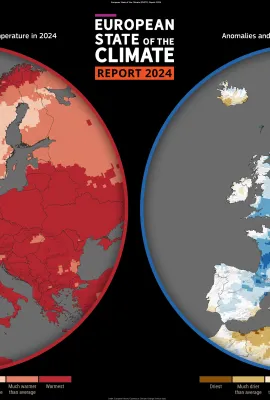
On 15 April 2025, the Copernicus Climate Change Service (C3S) released the ‘European State of the Climate 2024 Report’. According to its findings, 2024 was the warmest year on record in Europe. Record-high annual temperatures were reached in around 48% of the continent, particularly in central, eastern, and southeastern Europe. The report...
Showing 101-120 of 558 results