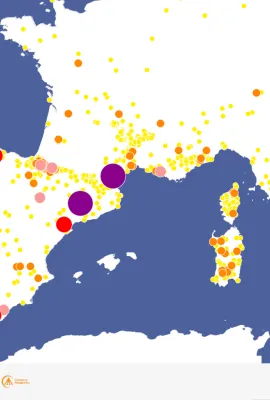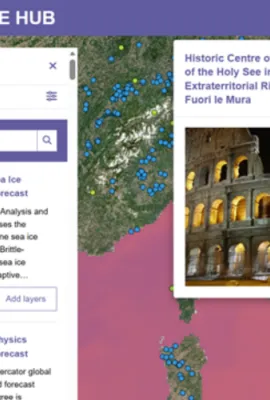
Across Europe and around the world, cultural and natural heritage sites face rising pressures from environmental change, urban development, natural hazards, illegal activities, and conflict.…
Results (283)
Through its advanced satellite technologies and space-based systems, the EU Space Programme is transforming how aircraft navigate, communicate, and operate across European airspace and beyond.…
According to the recently published Global Climate Highlights 2025 report from the Copernicus Climate Change Service (C3S), global temperatures remained close to historic highs in 2025, making it the…
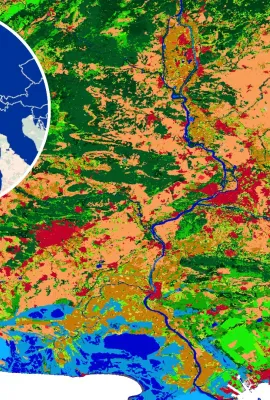
The Copernicus Land Monitoring Service is expanding its reach through its CLMS Snapshots, a new tool which uses interactive, visually rich story maps to bring land monitoring insights to wider…
A new era for European space connectivity is unfolding. With IRIS², the European Union is building a sovereign satellite constellation that will secure communications, protect critical…
As Europe approaches a decisive moment for its space ambitions, the 18th European Space Conference convened policymakers, industry leaders, and institutional stakeholders to reflect on the choices…
Europe’s risk landscape is changing rapidly, with climate-driven hazards and complex crises placing increasing demands on civil protection authorities. As disasters become more frequent, intense and…
The global population has quadrupled in just a century, reaching eight billion in 2022. A growing population means rising demand for food, making sustainable agriculture more critical and necessary…
Europe’s space strategy does not only rely on satellites and launch systems, but also on the digital infrastructures which connect people, ideas, and capabilities across the continent. As Europe’s…
Data from the Copernicus Atmosphere Monitoring Service (CAMS) confirmed the closure of the 2025 Antarctic ozone hole on 1 December, marking the weakest and shortest‑lived ozone hole in five years.…
Urbanisation is reshaping the world at a pace which has surpassed earlier expectations, altering how people live and how societies plan for housing, transport, and essential services.
The EU Space Networks have grown from more than a decade of EU-funded activities which explored how to bring satellite data closer to users. These early efforts evolved into the Copernicus Academy…
Following their successful launches in 2025, two new Copernicus satellite missions, Sentinel-1D and Sentinel-5A, have returned their first images, representing important progress in the EU’s capacity…
Europe is facing an increasingly complex mix of natural, technological, and human-driven risks, and the need for science which can guide preparedness is stronger than ever. At the EU Science for…
The summer of 2025 in Europe highlighted the growing impact of extreme heat. According to the Copernicus Climate Change Service (C3S) Climate Bulletins, successive heatwaves in June, July, and August…
Across Europe, the demand for space skills is rising quickly, with new projects creating opportunities which extend well beyond engineering. From climate monitoring to digital services enabled by…
The Copernicus Sentinel 1-D satellite successfully launched last night, 4 November, aboard an Ariane 6 rocket from Europe's Spaceport in Kourou, French Guiana.
As November approaches, the EU Space Programme is preparing for its next milestone in Earth Observation (EO): the launch of Copernicus Sentinel-6B, the second of two identical satellites in Europe’s…
Under the Danish Presidency of the Council of the European Union, the 2025 Space Conference in Aalborg brought together policymakers, researchers, entrepreneurs, and students to discuss Europe’s…
Showing 21-40 of 283 results