Through its newly adopted Horizon Europe work programme 2025, the European Commission is driving cutting-edge research and innovation, accelerating the European Union's green and digital transitions, and enhancing Europe's competitiveness. As part of Horizon Europe Cluster 4: Digital, Industry and Space, the call HORIZON-CL4-2025-02...
Results (253)
As European cities grapple with increasingly frequent and intense climate extremes, the need for data and models to support the design of timely, targeted adaptation has never been clearer. But how can policymakers translate Earth Observation (EO) data into meaningful local climate action? In this Observer, we look at a new report developed by...
Spring is well underway in Europe, making it the perfect time to prepare for an outdoor adventure! Whether you're gearing up for a hike or a weekend of camping in the mountains, EU Space data and services can help you plan ahead and stay safe.
Each year, the European Commission organises a General Assembly to bring together the EU Space Networks—a global community of Ambassadors promoting the uptake of EU space data and services across diverse sectors and regions. In 2025, for the first time, the General Assembly was co-organised with Italian members of the Networks, who selected...
The European State of the Climate 2024 (ESOTC 2024) report, jointly published on 15 April by the Copernicus Climate Change Service (C3S) and the World Meteorological Organization (WMO), reveals that 2024 was the warmest year, both for Europe and globally, since records began. Across the continent, people experienced dramatic and contrasting...
Students and startups joined the Copernicus Ocean Hackathon in Iceland to create innovative solutions using Copernicus Marine data and services to tackle the challenges. Additionally, a Copernicus Workshop series encompassed 3 days of hands-on learning about Land, Marine and Atmosphere using Copernicus data and services.
Every five years, the European Environment Agency releases a detailed report on the state of nature in Europe. The latest report—published in 2020—was a wakeup call for many.
EU Space Days 2025 lands in the Polish coastal city of Gdańsk on 27-28 May, bringing together the European space ecosystem for two days of high-level discussions, strategic insights, and the exploration of new cross-sector partnerships. Organised by the European Commission under the auspices of the Polish Presidency of the Council of the EU and...
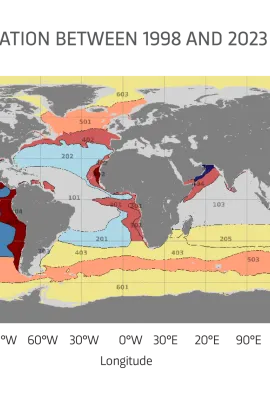
The ocean has taken centre stage across the world with the launch of the UN Decade of Ocean Science for Sustainable Development, which puts forward ten major ocean challenges. The Copernicus Marine Service’s data support scientists, policymakers, and ocean stakeholders in addressing these challenges and support the contributes to the progress...
We rely on satellites more than we may realise—whether it’s for weather forecasting, global navigation, or critical communication systems. However, as our dependence on space-based technologies grows, so does the threat posed by the clutter of space debris surrounding Earth. Space Situational Awareness (SSA) is essential for ensuring the...
In 2024, the planet experienced extremes which were unprecedented in the instrumental record, highlighting the ongoing impact of human-induced climate change. In addition to record global temperatures which made 2024 the first year with an average temperature clearly exceeding the threshold of 1.5°C above the pre-industrial level set in the...
How will snow loads change in the future? The FPCUP SNOWLOADS C3S app prototype provides data on present and future snow loads, helping users prepare for the future.
2024 saw South America in the grips of a wildfire crisis, with some countries and regions experiencing record-breaking emissions and severe air quality impacts, as highlighted in the annual wildfires review of the Copernicus Atmosphere Monitoring Service (CAMS). In addition to the destruction and tragic loss of life and biodiversity, wildfire...
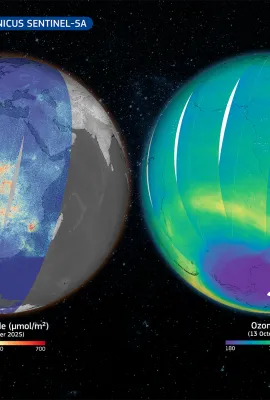
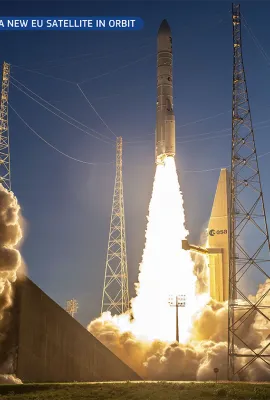
Air pollution is one of Europe’s most pressing environmental and public health challenges. To ensure the continued growth of Copernicus Earth Observation (EO) data and services, the European Commission is expanding the Copernicus constellation with new satellite missions in 2024 and 2025. Among them, Copernicus Sentinel-4, set to launch in...
On Tuesday, DG DEFIS hosted the 7th meeting of the EU Industry and Start-ups Forum on Space Traffic Management (EISF).
The EU defence, aeronautics, and space sectors thrive on innovation, but can they truly innovate if entire groups of talented people are left out? Today, these industrial sectors are among the least diverse in Europe, with barriers preventing many from accessing or advancing within them. According to a recent Union of Equality report, in the...
Copernicus continues to demonstrate its responsiveness to the needs and demands of the user community with the recently announced exceptional and temporary extension of the availability of the data from the Sentinel-2A satellite mission for one year. In September 2024, the third Copernicus Sentinel-2 satellite (Sentinel-2C) was successfully...
One of the top priorities is the full rollout of the EU’s Space flagship programmes: Galileo, Copernicus, SSA (Space Surveillance and Awareness), and GOVSATCOM. These programs will be further enhanced to ensure that Europe remains at the forefront of space innovation and security.
On 30-31 January 2025, DG DEFIS co-organised the first-ever UN Space Sustainability Days together with the United Nations Office for Outer Space Affairs (UNOOSA) in Vienna, Austria.
Floods remain one of the most complex and devastating natural hazards, impacting lives, infrastructure, and economies around the world. The increase in their frequency and magnitude due to climate change make the development and use of early warning systems (EWS)—capable of mitigating risks through advanced forecasting and preparedness...
Showing 41-60 of 253 results