
Copernicus Data Access
At the heart of Copernicus is a constellation of satellites – the Sentinels – that make a huge number of daily observations of the Earth ecosystem. The technological prowess of Copernicus, especially in terms of availability and accessibility, has made Copernicus the largest space data provider in the world.
The Copernicus Data Ecosystem
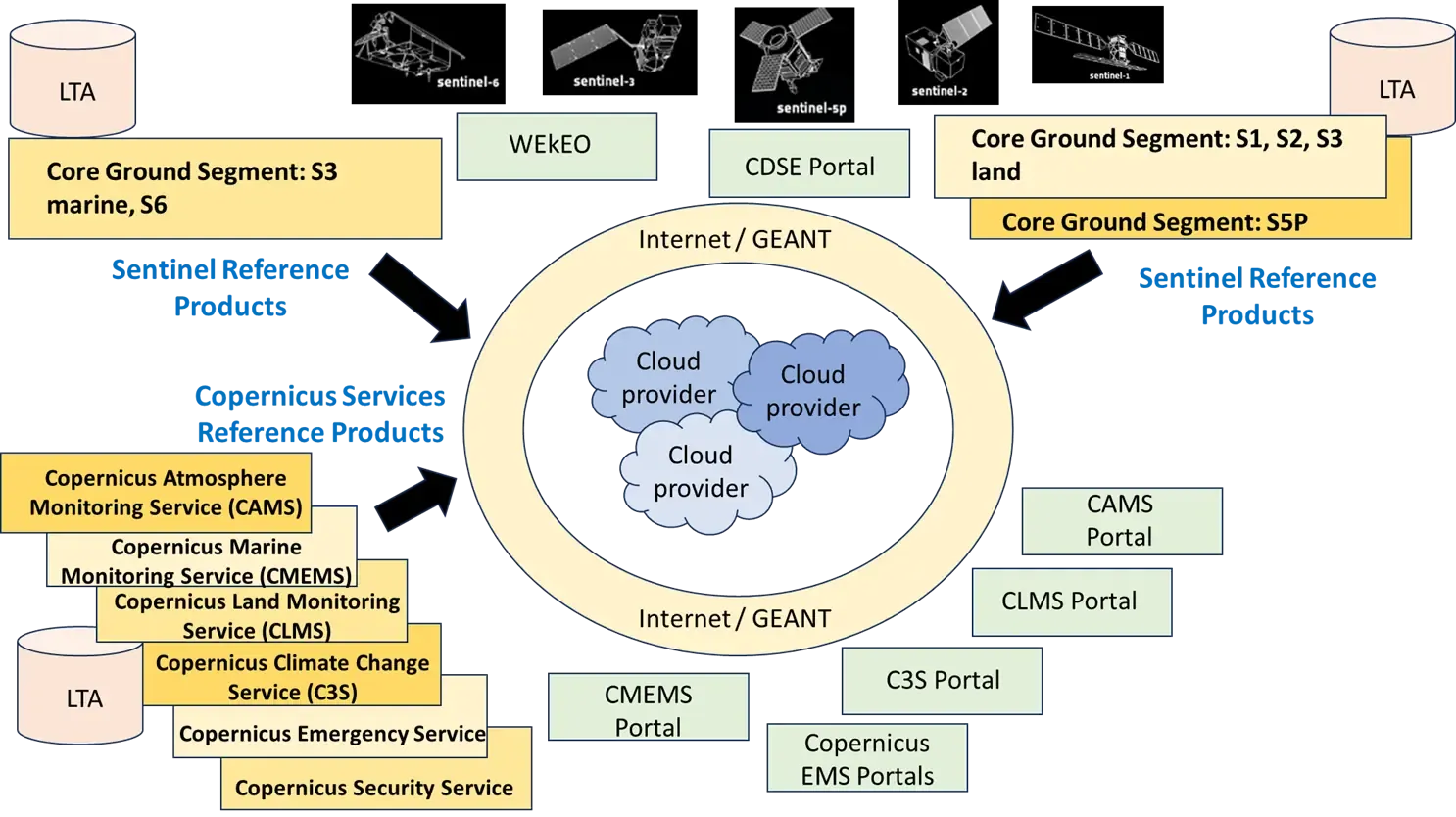
The main components are:
- The Copernicus Space Component represented by the current set of Sentinel satellites.
- The Core Ground Segment elements command and control the Sentinel satellites, acquire the Sentinel data on-ground, and generate the Sentinel Reference Products. The reference products are archived locally in a Long Term Archive (LTA) in order to securely store the data over long periods of time.
- The Copernicus Services elements take the Sentinel Reference Products and use them, along with other data sources, to derive Copernicus Services Reference Products. Each of the Copernicus Service addresses a specific theme. The reference products are archived locally in a Long Term Archive (LTA). More details on the Copernicus Services can be found on the Copernicus Services page.
- The reference products are made available via network transfers to cloud storage providers by the Core Ground Segment elements and the Copernicus Services elements.
- A series of web portals allow users to access the available reference products. Each web portal is designed to address a specific set of user needs. Each portal also offers a variety of data access mechanisms. One common data access mechanism is to allow the user to download the data to their local machine. Another common data access mechanism is to have the user access the data directly in a cloud computing environment associated to the cloud storage.
Open Data Policy
The vast majority of data and information delivered by Copernicus is made available and accessible to any citizen, and any organisation around the world, on a free, full, and open basis.
Information on copyright and licenses:
Learn the terms for using the Copernicus trade marks and logos, including permitted uses, graphical specifications, and how to register. Find out how to reference Copernicus correctly in your work.
Copernicus Contributing Missions
In addition to data from the Sentinel satellites, Copernicus offers data from a global network of other satellites (the Copernicus Contributing Missions) and land, air, and marine-based sensors to create a detailed pictures of the Earth ecosystem.
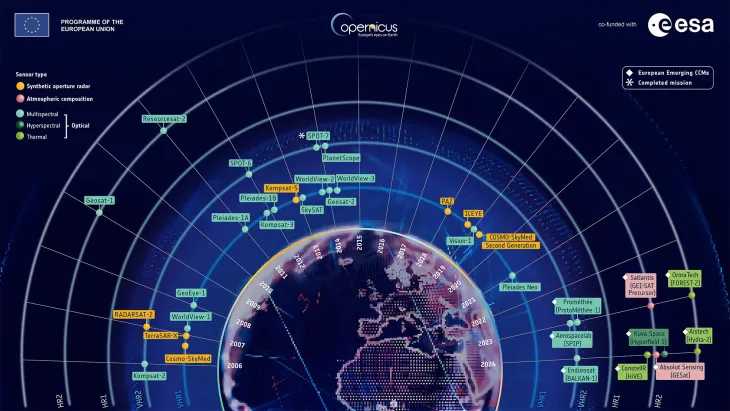
Contributing Missions are missions from ESA, their Member States, Eumetsat and other European and international third party mission operators that make some of their data available for Copernicus.
Frequently Asked Questions
Although primarily designed for public policy-makers and public bodies responsible for environmental and security matters, data and information provided by Copernicus are not limited to these users. Any public or private organisation, and more generally any individual can access and exploit Copernicus data and information on a free, full and open basis.
The only exceptions are the specific situations where security is at stake. In such cases, access limitation may exist.
Practically, Copernicus information is provided to users through a set of services, most of them being available online.
The Copernicus Programme covers six thematic areas: land, marine environment, atmosphere, climate change, emergency management and security.
The data delivered by the Sentinel satellites and the data and information delivered by the Copernicus Services are made available to users through web portals. In most cases, data and information can be browsed and discovered without prior registration, but registration is required for downloading.
Yes. Considered as public goods, the Earth observation data delivered by the Sentinel satellites and the data and information delivered by the 6 Copernicus services are available to users on a free, full and open basis.
Note that based on the free data and information delivered by Copernicus, public or private operators may develop value-added services ("downstream services") with the objective to meet specific needs. Depending on the business model adopted by each operator, these downstream services can be either free for the final user or associated to a fee.
The implementation and operation of Copernicus services has been delegated by the European Commission to dedicated service providers – the Copernicus Entrusted Entities – through a series of "Delegation Agreements" signed during the period November 2014 – October 2016.
These Entrusted Entities are responsible for the delivery of the Copernicus Services. Visit the Copernicus Services section to know more about the Entrusted Entities.
Copernicus Data Portals
Copernicus generates over 22 terabytes of data daily. This data is made available on a free, full and open basis to users worldwide. Access is provided through dedicated Copernicus Data Portals, offering:
- reliable and standardised datasets
- near real-time information
- user-ready products and tools
Access to Copernicus products from Sentinel satellites with visualisation tools, data processing, and cloud environment.
Free unified access to environmental data, processing tools, and expert support from environmental Copernicus Services.
Why Use Copernicus Programme Portals?
The portals of the Copernicus Programme offer a trustworthy, well-documented, and reliable source of timely high-quality data in the form of reference products.
The portals of the Copernicus Programme are the publicly exposed part of a large data ecosystem built on the Sentinel satellite missions. Sentinel Reference Products are generated by Core Ground Segments and Copernicus Services Reference Products are generated by the Copernicus Services using as input the Sentinel Reference Products and other data sources. These reference products represent high-quality data that is generated in an operational environment subject to configuration control and monitoring. Reference products can be clearly identified and, in many cases, authenticated by the user.