

Horizon Europe
EU Space Research Funding
EU space research is supported through framework programmes. The support of these programmes is critical to the ongoing development of the space sector. In particular:
- It encourages the research community and the private sector to intensify their efforts in the space sector and boost investment;
- It helps to sustain a competitive space industry including manufacturers, service providers, and operators;
- It provides the services and infrastructure necessary for the development and exploitation of new technologies
Horizon Europe
The regulation establishing Horizon Europe, the new framework programme for research and innovation for 2021-2027, was adopted in April 2021 with a total budget of €86,1 billion in current prices[1]. In addition, the NextGenerationEU programme, which was set up as a temporary recovery instrument following the COVID-19 crisis, will contribute an additional €5,4 billion.
The programme is structured in three pillars: open science, global challenges and Industrial and Open Innovation. Space is under the second pillar in a joint Cluster' Digital, industry and space' with a proposed envelope of €13,5 billion and an additional €1,35 billion from NextGenerationEU. Within that, Space has approximately €1,95 billion for the 2021-2027 period.
For the first two years of Horizon Europe, Space Research and Innovation is structured as shown in Figure below:
Regulation (EU) 2021/695 of the European Parliament and of the Council of 28 April 2021 establishing Horizon Europe – the Framework Programme for Research and Innovation, laying down its rules for participation and dissemination, and repealing Regulations (EU) No 1290/2013 and (EU) No 1291/2013 (Text with EEA relevance)
In order to stay ahead in a dynamically changing domain marked by growing competition and major technology advances, the EU space sector requires continued, smart and coordinated investments in cutting-edge technologies, innovation, applications and skills. The Horizon Europe programme is a major leverage to boost space innovation across the EU with around €1.95 billion over the programming period 2021-2027.
Funded R&I projects foster competitiveness and technological non-dependency of the EU space sector while consolidating EU flagship programmes and developing new downstream applications and evolution schemes for the existing services of the European Union Space Programme. EU-funded space R&I projects also emphasise European access to space as well as future technologies such as quantum technologies, space weather and space science.
The research under:
- foster the competitiveness of the EU space sector
- reinforce the EU capacity to access and use space
is guided by a Strategic Research and Innovation Agenda (SRIA)2 for EU-funded space research supporting competitiveness. It has been developed with the stakeholder's community and constitutes an important input for R&I programming under Horizon Europe.
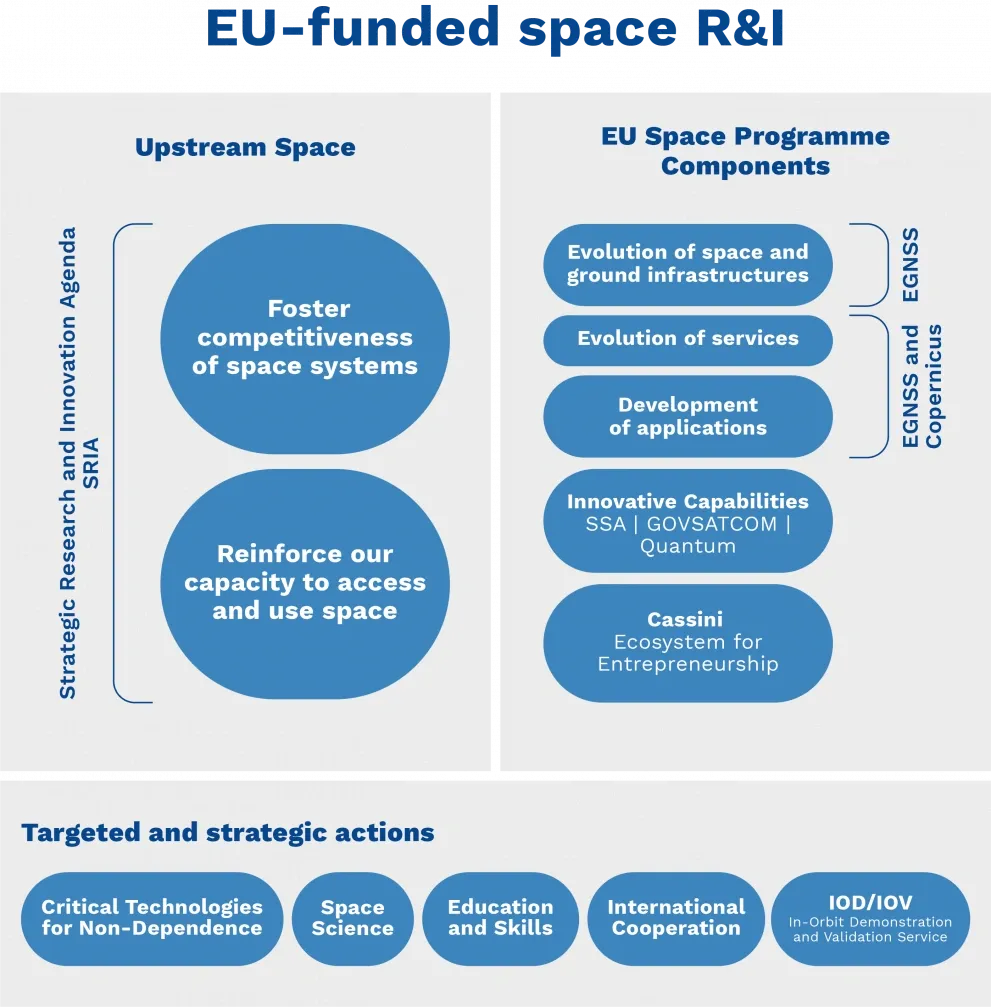
Horizon Europe also funds R&I for the new Space Programme of the Union, which regroups in a single programme the four components EGNSS, Copernicus, Space Situational Awareness (SSA) and secured governmental communications (GOVSATCOM). In addition, three horizontal activities support access to space, start-ups and security.
It is foreseen that R&I for the Space Programme will:
- Continue to support the evolution of space and ground infrastructures for the two EU flagship constellations Galileo and Copernicus,
- Foster the evolution of EGNSS and Copernicus services,
- Contribute to the development of innovative downstream applications, including by combining EGNSS and Copernicus services with other services,
- Develop innovative space capabilities for SSA, GOVSATCOM and pave the way for quantum technologies in EU space infrastructure (the last is not part of the Space Programme).
Furthermore, actions will be undertaken to:
- Develop a space entrepreneurship ecosystem called Cassini
- Support activities of interest and cutting-across all the above activity lines such as critical technologies for non-dependence, In-orbit validation ("IOV") and in-orbit demonstration ("IOD") services, contribute to space science and missions, outreach and education activities and international cooperation.
Governance and Implementation of Horizon Europe
The Horizon Europe programme is governed by the Directorate-General in charge of Research and Innovation. More information about the overall programme, which does not only cover Space, can be found here.
For the Space component of Horizon Europe, the implementation of the programme is managed by the Executive Agency HaDEA and, for some areas such as EGNSS and Copernicus downstream applications as well as the Galileo PRS service’s applications, by EUSPA, the EU Agency for the Space Programme.
Horizon Europe also supports actions which are delegated to specific entities, mostly ESA, the European Space Agency, for example related to the evolution of the EGNSS programmes.
Space Research and Innovation
CASSINI is the European Commission's initiative to support entrepreneurs, start-ups and SMEs in the space industry, including New Space, during 2021-2027.
Enhance the performance, resilience and sustainability of space assets through advanced in-space operations and services.
Ensuring access to critical space technologies is key to our economy, society and security. Bolstering space research activities in support of EU's strategic autonomy is a key priority for the European Commission.
Developing and deploying a Quantum Communication Infrastructure (QCI) with a terrestrial and space segment
The EU invested in space R&I and implemented various programmes to ensure that the EU remains competitive in space and has the capacity to access and use space with a high level of autonomy. EU space research introduced several framework programmes.
In-Orbit Demonstration and Validation (IOD/IOV) is a Union programme allowing new technologies to be tested in orbit by providing aggregation, if needed, launch services and operations.