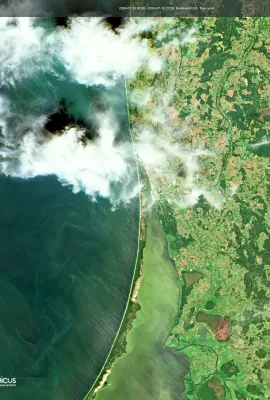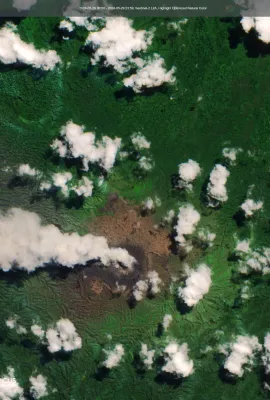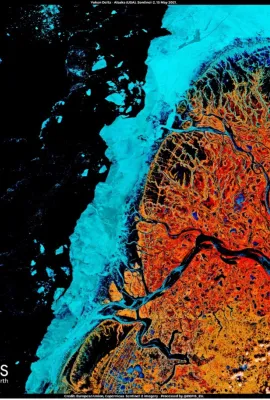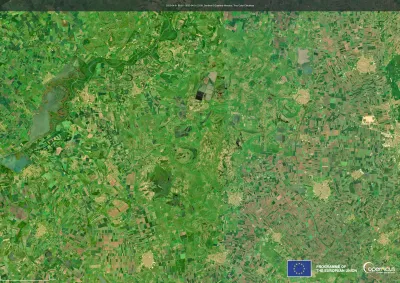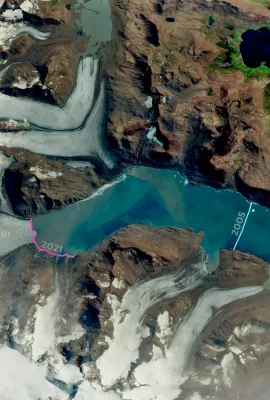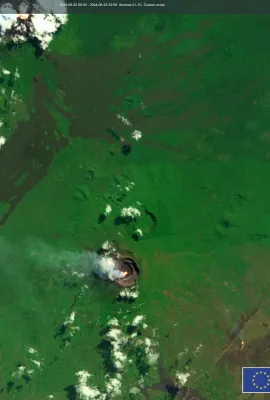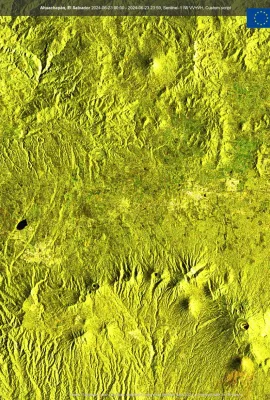
The Delta del Estero Real is located along the country's Pacific coastline and spans across Nicaragua, Honduras and El Salvador. This expansive delta, formed by the convergence of the Estero Real and the Pacific Ocean, is a biodiverse haven where lush mangrove forests of several species thrive. Part of the site was declared a Reserve for...
Results (1987)
The North of Europe has been affected by low temperatures and snow covered many European capitals. On 20 January 2024 one of the Copernicus Sentinel-2 satellites acquired this image of the city of Brussels under a white robe of snow. The Copernicus Land Monitoring Service product portfolio includes Snow & Ice (HR-S&I) Monitoring products, which...
Cold temperatures caused snowfalls which affected many areas of the northern hemisphere over the past week. Many countries are currently blanketed, with snow with accumulations of up to 15 cm in some areas of northern Europe. The snow has caused traffic disruptions in several regions. This image acquired by one of the Copernicus Sentinel-3...
On 17 January, a snowstorm hit northern and central France, prompting the authorities to issue an orange alert in 21 departments and a yellow alert in many other affected areas. The storm had a major impact on transport, causing widespread traffic jams over hundreds of kilometres of roads and motorways. This image acquired by one of the...
Large parts of central and northern Europe are under snow and below-average temperatures. On 17 January, the Oslo airport had to cancel flights, and train services were suspended in parts of Norway due to the heavy snowfall. There were also many snow-related transportation issues in Central Europe. In Belgium, trains were cancelled, and a red...
In November 2023, at the EU Space Week, the Copernicus Thematic Hubs were officially launched. They focus on specific thematic areas and regions, namely, for the first four, energy, health, coastal zones and Arctic regions. This was an important milestone for Copernicus and the entire Earth Observation (EO) community. In this series of...
FPCUP Consortium | Brussels | English
The Sau Reservoir, (or Pantà De Sau) is located in Cataluña, Spain, and serves as a water source for numerous villages and towns in the area, including Barcelona. The reservoir was created by flooding an old village called Santa Romà de Sau about 60 years ago. Recently, the water level in the Reservoir has decreased significantly, dropping to...
On 15 January 2024, Cyclone Belal hit Mauritius and the French island of La Réunion, bringing torrential rain and strong winds to the region. At least one casualty has been reported in La Réunion, where a level three cyclone warning has been issued, and a quarter of the population has been left without electricity and drinking water. This...
Iceland is one of the world's most active volcanic regions. On 14 January, an eruption occurred on the Reykjanes peninsula near the town of Grindavik, which had been evacuated earlier due to increased seismic activity and the threat of a volcanic eruption. This image acquired by one of the Copernicus Sentinel-3 satellites at 13:10 UTC, a couple...
Project results were shared at the 13th Nordic National and Mapping Agencies Meeting on Aerial Photography & LiDAR Scanning in Gävle, Sweden.
The Seoul (Korea) metropolitan area, visible in this image acquired by one of the Copernicus Sentinel-2 satellites on 3 December 2023, is home to 26 million people. A recent report by the United Nations Environment Programme (UNEP) on air quality in the metropolis has revealed that, in 2005, the levels of harmful air pollutants, such as...
The San Bernardo Archipelago, visible in this image acquired by one of the Copernicus Sentinel-2 satellites on 6 January 2024, is located in the Caribbean Sea off the northern coast of Colombia. Consisting of 10 main islands, the archipelago is renowned for its pristine white sand beaches, crystal clear turquoise waters and rich marine...
The Copernicus Climate Change Service (C3S) has just released its annual climate summary for 2023.These data visualisations, based on CS3 and the EUMETSAT’s Ocean and Sea Ice Satellite Application Facility (OSISAF) data, illustrate the monthly sea ice extent around Antarctica in 2023. It reached an all-time minimum extent in February 2023 (33%...
The Copernicus Climate Change Service (C3S) has just released its annual climate summary for 2023, which highlights that 2023 has replaced 2016 as the warmest calendar year on record. Based on C3S data, these data visualisations illustrate the monthly Sea Surface Temperature (SST) anomalies for the global ocean in 2023, compared to the averages...
In November 2023, Copernicus, the Earth Observation component of the European Union’s Space Programme, launched four Copernicus Thematic Hubs. These hubs serve as single entry points to data and products generated by different Copernicus services on specific regional or thematic areas. The main objective of these hubs is to streamline user...
The Copernicus Climate Change Service (C3S) has just released its annual climate summary for 2023, which highlights high variability across Europe and extreme weather events. These data visualisations, based on CS3 data, illustrate the surface air temperature monthly anomalies for Europe in 2023, compared to the averages for the 1991-2020...
The Charco Redondo Reservoir, visible in this image acquired on 8 January by one of the Copernicus Sentinel-2 satellites, is located in the province of Cádiz, Spain. It plays a crucial role in providing water for agricultural irrigation and supporting local wildlife, and serves as the primary source of water for the Campo de Gibraltar area and...
The formation of sea ice in the Baltic Sea has been favoured by the cold temperatures recorded in Scandinavia at the beginning of 2024. The ice cover is the most extensive since 2011 and about 4 times larger than usual at this time of the year, according to the Finnish Meteorological Institute. The entire Bothnian Bay is covered with sea ice,...
Showing 1021-1040 of 1987 results