
Estimation of snow load data using Copernicus and in-situ data
The joint action by the FPCUP internal Working Group “Snowloads” with partners from Deutscher Wetterdienst (DWD), Centre national de la recherche scientifique (CNRS), Finnish Meteorological Institute (FMI) and Politecnico di Milano (POLIMI) addresses the development of a Copernicus Climate Change Service (C3S) App on the Climate Data Store (CDS) for a Europe-wide provision of snow load climatological information for civil engineering as well as hazard and damage prevention purposes. Three pilot downstream services will use the data of the C3S App as basic and background information on snow loads and will enrich them with current snow load information in the pilot regions Bavaria (Germany), Uusimaa (Finland) and Lombardia (Italy). The C3S App will provide Europe wide maps of snow load related parameters and will make available a basic dataset of snow load information. Since it will be based on CDS tools, it can be linked from or embedded into other web applications, as it is planned for the snow load information downstream services in the pilot regions. The C3S App and the additional pilot downstream services will strictly consider the requirements of the end users, i.e., their specific requirements on design, use of data, spatial resolution and continuous time intervals. The output data at climate time scales (e.g., snow load maps) will be available by free and open access through OGC standards (e.g., by open C3S App standard, by Web Mapping Services WMS). The user requirements will be identified by workshops and inquiries (organized for different user groups and in different regions).
Outputs and Results:
- C3S App that will make available snow load related parameters on the basis of data available on the CDS considering the specific requirements of end users, at the pan-European scale.
- Pilot snow load information downstream services in the pilot regions Bavaria (Germany), Uusimaa (Finland) and Lombardia (Italy).
- Workshops held in the beginning and the end of the action (request of user requirements, final dissemination of results and user feed-back).
- User experience/feedback sessions during the action.
- User advice document on how to use the snow load data from the C3S App as a basis for the preparation of national snow load maps by National Standardization Bodies in Europe.
Supporting Material
The online user workshop on extreme snow loads across Europe under climate change was a great success.
DWD, CNRS, FMI, and POLIMI | Online | English
FPCUP SNOWLOADS organized a user workshop in Munich to present the current status of the project and to interact with potential users of the developed app-prototypes.
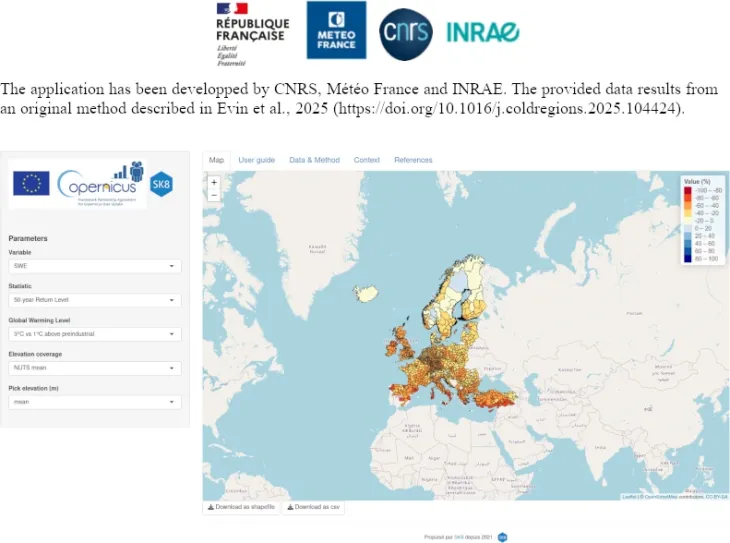
How will snow loads change in the future? The FPCUP SNOWLOADS C3S app prototype provides data on present and future snow loads, helping users prepare for the future.
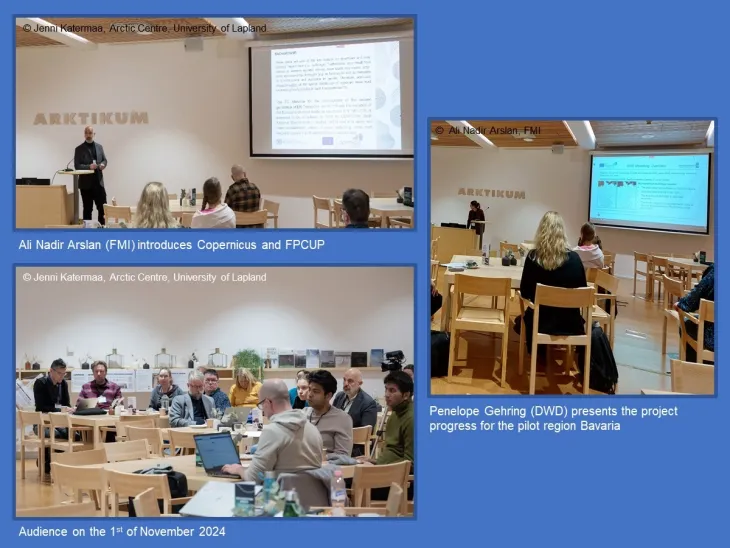
The 12th National Seminar on Snow, held on the name day of "Pyry" (meaning "blizzard" in Finnish), took place at the Arctic Centre in Rovaniemi. The event included a session by FPCUP SNOWLOADS, reaching a wide audience and presenting key results.
Starting November 1st, 2024, an updated version of the snow load information system for Bavaria is available as a second German test version.
FMI | Rovaniemi, Finland | English & Finish
DWD | Munich | German
Report on the user workshop "Snowload – Past, Present and Future" held in April 2024.
Report on the results of the user survey on snow load information systems that was conducted in Germany in the year 2023.
DWD | Online | German
In February 2024, the first version of the snow load information system for Bavaria was made available as a German test version.
In September 2023, during the 6th C3S General Assembly the C3S app SNOWLOADS was promoted with a poster.
In August 2023, a user survey was published to determine user requirements for snow load information systems.
In June 2023, the DWD launched a new German website for the snow load information system for the pilot region Bavaria.
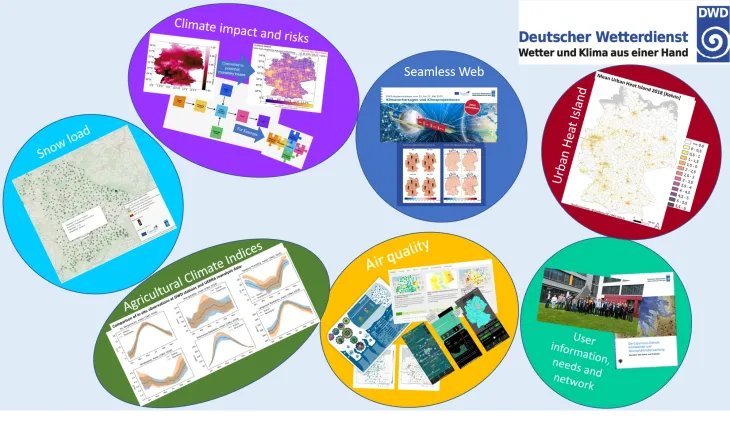
Highlighting the high variety of topics and thus the potential to reach many different users, projects with contribution of the German Meteorological Service are outlined