The Étang de Biguglia is the largest lagoon in Corsica, France. Designated as a Ramsar Site, the lagoon covers approximately 1,800 hectares and is known for its rich biodiversity. It provides a crucial habitat for a variety of bird species, 18 of which are protected under the EU Habitats and Birds Directives. It is also home to a diverse range...
Results (1081)
Located on the northern side of the Grossglockner, the highest peak in Austria, the Pasterze Glacier is the longest glacier in the country and in the Eastern Alps. Situated in the Hohe Tauern mountain range and spanning around 15 km2 in area, the glacier is a stunning natural wonder, attracting hikers, climbers, and tourists to experience its...
14 March is the International Day of Action for Rivers, dedicated to honouring the role of rivers in supporting the health of the environment and life on Earth. An example of one important river is the Po, the longest river in Italy. Rising in the Cottian Alps and emptying into the Adriatic Sea, the Po’s drainage basin covers over 70,000 km2,...
As one of the world’s most vulnerable countries to disasters and the consequences of climate change, the Philippines is facing increasing environmental pressure. One challenge facing the country includes ground subsidence, which poses a particular threat to metropolitan areas in the Philippines by increasing risks of flooding, infrastructural...
On 9 March 2025, the Fuego Volcano in Guatemala began erupting, prompting the evacuation of over 300 people in the vicinity. The National Coordinator for Disaster Reduction of Guatemala (CONRED) issued an orange alert, recommending that communities near the volcano prepare accordingly. Guatemalan authorities reported that the eruptive phase had...
The Copernicus Climate Change Service (C3S) has published its latest monthly Climate Bulletin, focused on key climate trends in February 2025. The bulletin reports that February 2025 was the third warmest February on record globally, with an average surface air temperature of 13.36°C, 0.63°C above the 1991-2020 average for the month....
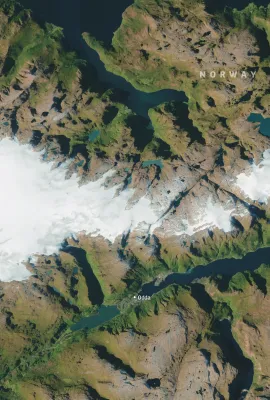
Hornindalsvatnet, located in western Norway, holds the title of Europe’s deepest lake, reaching a depth of 514 metres. Unlike many other Norwegian lakes, it is not fed by glacial rivers, therefore resulting in exceptionally clear water. The lake is located within a spectacular landscape of steep valleys and rugged mountains, making it a...
This image, acquired by one of Copernicus Sentinel-2 satellites on 2 September 2024, shows the Arctic coastline of Canada’s Yukon territory, where land meets the dynamic waters of the Beaufort Sea. In the image, Herschel Island (Qikiqtaruk), Avadlek Spit, and the Firth River delta are visible, all of which are affected by coastal and riverine...
This image, acquired by one of the Copernicus Sentinel-2 satellites on 5 November 2024, shows the Vipava Valley in southwestern Slovenia. Known for its mild Mediterranean climate, fertile lands, and strong winds, the valley is an important agricultural region, particularly for vineyards and fruit production. The Vipava River, which meanders...
This image, acquired by one of the Copernicus Sentinel-2 satellites on 5 March 2025, shows Mount Teide in Tenerife, Canary Islands, Spain, covered in fresh snow. Following a weekend of heavy rain and sub-zero temperatures brought by a storm system, officially known as an upper-level isolated depression (DANA), snowfall began on 2 March 2025....
Valais is a canton in southwestern Switzerland, bordering Italy to the south. Home to some of the highest peaks in the Swiss Alps, including the famous Matterhorn, its stunning alpine landscapes and ski resorts make it a popular tourist destination. The canton is also the country’s main wine-producing region. Valais includes the valley of the...
At the beginning of March 2025, a high-pressure system over Europe created stable atmospheric conditions, influencing air quality across the continent. The image on the right shows data acquired by the Copernicus Sentinel-5P satellite on 3 March 2025, highlighting nitrogen dioxide (NO₂) concentrations. Higher levels are observed over parts of...
Since January 2025, heavy rainfall has affected 23 out of 24 provinces in Ecuador, leading to flooding, landslides, and destruction of infrastructure. With nearly 20,000 people impacted, the country’s government has declared a state of emergency in eight coastal provinces. On 26 February 2025, the Copernicus Emergency Management Service (CEMS)...
Liepāja is one of Latvia’s key port cities, located on the country’s southwestern coast along the Baltic Sea. Liepāja lies on the Curonian Lagoon, a large body of water separated from the open Baltic Sea by the Curonian Spit, a narrow strip of land which extends along the coast. The city is often referred to as the "city where the wind is born"...
The Plitvice Lakes National Park, located in central Croatia, is the country’s oldest and largest national park, spanning nearly 300 square kilometres. Thanks to its unique formation of tufa (traverine), the park was listed as a UNESCO World Heritage site in 1979. Though famous for its stunning cascading lakes, these cover just under 1% of the...
Dokkum, located near the Wadden Sea, is a historical city in the province of Friesland in the Netherlands. This UNESCO World Heritage site is known for its dynamic tidal flats and barrier islands. The region is characterised by a mix of agriculture, wetlands, and coastal ecosystems which support diverse wildlife. This image, acquired by one of...
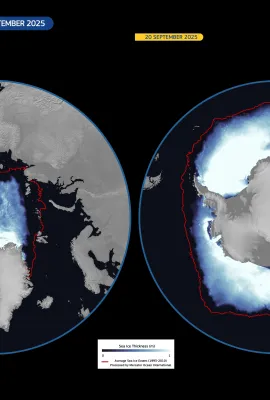
In early February 2025, the world’s sea ice fell to a record low, with the combined Arctic and Antarctic sea ice extent totalling 15.76 million square kilometres. Arctic sea ice has consistently declined for decades, while Antarctic ice, once stable, has entered a new phase of decreasing extents. This Copernicus Sentinel-3 image, acquired on...
Jan Mayen is a Norwegian island situated in the North Atlantic Ocean, around 600 km northeast of Iceland and 950 km west of Norway. The island, with an area of 373 km2, is home to the world’s northernmost active volcano above sea level, called the Beerenberg. Its Arctic environment is characterised by cold temperatures, strong winds, and...
This Copernicus Sentinel-2 image, acquired on 1 February 2025, shows an algal bloom in the Salto Grande reservoir, at the border between Argentina and Uruguay. In early February 2025, Lake Salto Grande was affected by a surge in algae growth. This phenomenon has affected local fauna, including capybaras, which have been observed with their fur...
Romania was affected by its coldest week of the winter between 17 to 24 February 2025. The extreme temperatures, which dropped as low as -20°C in some mountainous regions, were accompanied by heavy snowfall. Authorities issued a yellow weather warning for much of the country’s south and southeast regions, including the capital Bucharest, due to...
Showing 361-380 of 1081 results