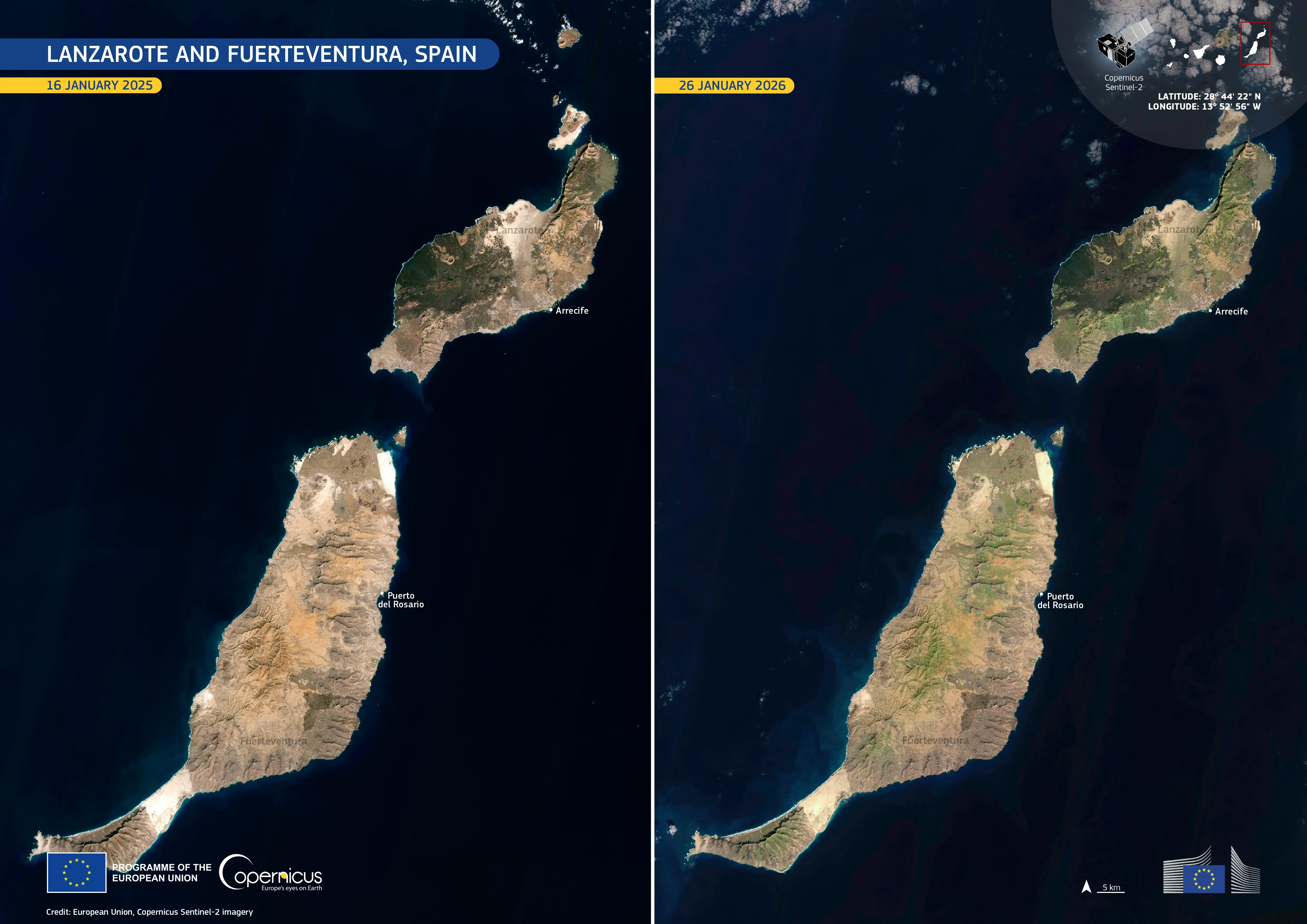
Lanzarote and Fuerteventura turn green after above record precipitation, Spain
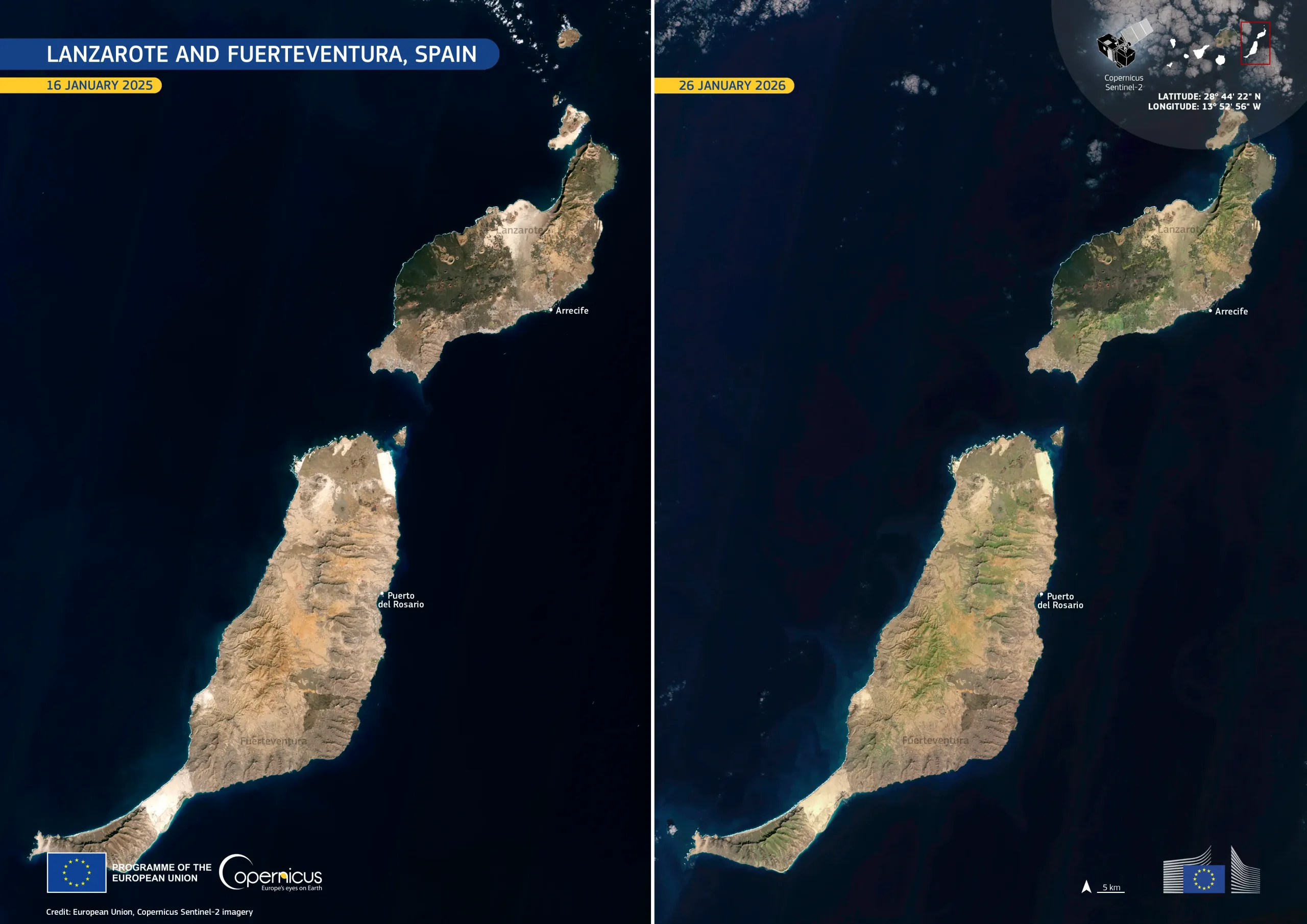
Lanzarote and Fuerteventura are two of the easternmost Canary Islands, located in the Atlantic Ocean off the north-western coast of Africa. The islands are characterised by an arid to semi-arid climate, limited freshwater resources, and predominantly volcanic and sandy terrain, which generally restrict the development of natural vegetation.
Since mid-December 2025, precipitation across Lanzarote and Fuerteventura has been well above historical records. As a result, the islands no longer show the characteristic ochre and golden tones of their volcanic and sandy landscapes. Instead, hills, valleys, and volcanoes are covered by widespread vegetation. This transformation is clearly visible when comparing these images, acquired by one of the Copernicus Sentinel-2 satellites. The image on the left shows the islands on 16 January 2025, when dry conditions, seen in ochre tones, dominated. The image on the right shows the islands on 26 January 2026, when extensive vegetation is visible across large areas following sustained rainfall.
Copernicus data support the monitoring of vegetation recovery, drought stress, and erosion risk, supporting water management and conservation planning.