In early January 2026, severe rainfall affected the Lazio region in Italy, with river levels rising rapidly in several areas. As a result, regional and national civil protection authorities issued…
Results (1242)
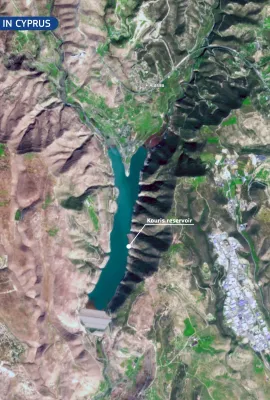
Cyprus, the third-largest island in the Mediterranean Sea, is characterised by a diverse landscape shaped by mountains, plains, and an extensive coastline. Despite its semi-arid climate, the island…
On 1 January 2026, Mount Etna entered a new eruptive phase, with lava emerging from a fissure vent located approximately 2,000- 2,100 metres above sea level in the Valle del Bove. According to…
In early January 2026, heavy snowfall and icy conditions affected large parts of the Netherlands, triggering a severe weather alert in several provinces. The widespread snow cover led to major…
Greenland’s mountains are crucial for shaping regional climate patterns, influencing ice-sheet dynamics, and directing meltwater to the coast. They also host some of the world’s largest outlet…
On 3 December 2025, waters along Belgium’s North Sea coast showed clear colour contrasts, revealing active sediment dynamics driven by tidal currents and shallow bathymetry. Such conditions favour…
São Paulo is the largest city in Brazil and a key economic hub in Latin America. Located in the south-eastern region of the country, it serves as the capital of the state of São Paulo. The city has…
Sal Island, part of the Cape Verde archipelago in the eastern Atlantic Ocean, is characterised by a flat, arid landscape shaped by volcanic origins and persistent trade winds. The island and its…
2025 represented an unprecedented year for the EU Space Programme, particularly regarding the expansion of the Copernicus Sentinel family. Europe achieved a notable pace of satellite deployments,…
Daugavpils, Latvia’s second-largest city, lies to the south-east of the country and has long served as a key regional centre. Its development and identity are closely tied to the Daugava River, which…
The Teshekpuk Lake Special Area, situated on Alaska’s North Slope, is one of the most ecologically important Arctic wetland systems in North America. Recognised for its high conservation value, the…
Iceland’s glaciers are among the most prominent in Europe and play an important role in regulating freshwater resources and sea level contribution. In recent decades, they have shown sustained…
The Istrian Peninsula, the largest peninsula in the Adriatic Sea, is a region of high ecological value. It hosts a mosaic of karst hills, coastal wetlands, and productive marine habitats which…
The 2025 Antarctic ozone hole closed on 1 December, marking the earliest closure since 2019. This year’s ozone hole was also relatively small for the second consecutive year, especially when compared…
Located in southern Chile’s Los Ríos Region, the city of Valdivia has been internationally designated under the Ramsar Convention as Latin America’s first “Wetland City”. The recognition comes after…
The recently published Forest Fires in Europe, Middle East and North Africa 2024 Report, based on data from the European Forest Fire Information System (EFFIS), indicates that although last year’s…
After reaching the second-lowest extent on record in November 2025, sea ice extent in the Arctic remained unusually low into December. Data from the EUMETSAT Ocean and Sea Ice Satellite Application…
In autumn 2025, persistently warm conditions combined with limited rainfall led to persistent drought conditions across the Iberian Peninsula. As rainfall deficits accumulated, soil moisture levels…
The agricultural landscape surrounding Prague reflects the long-standing importance of farming in the Czech Republic, where arable land supports both national food production and rural livelihoods.…
La Niña is a naturally occurring climate phenomenon characterised by cooler-than-average sea surface temperatures in the central and eastern equatorial Pacific Ocean. It is part of the El…
Showing 221-240 of 1242 results