European Union flag
EU Space Policy

Explore EU Space

Results (1080)
Image of the Day
First image of nitrogen dioxide from Copernicus Sentinel-4
Earth Observation | Copernicus
The new Copernicus Sentinel-4 mission has delivered its first images, highlighting concentrations of atmospheric nitrogen dioxide, sulphur dioxide and ozone.  This image, based on the Sentinel-4 very first measurements acquired on 8 October 2025, depicts tropospheric nitrogen dioxide with clear pollution hotspots visible along the Mediterranean...
Image of the Day
The impact of drought on Lake Mornos, Greece
Earth Observation | Copernicus
Lake Mornos is an artificial reservoir in central Greece, serving as a primary water source for Athens. According to national authorities, the lake has lost nearly half of its water volume  over the past four years, decreasing its surface water extent from around 19.1 km² in early 2022 to 8.7 km² by September 2025. The decrease in the lake’s...
Image of the Day
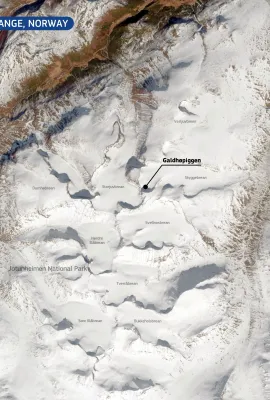
The Folgefonna Glacier, Norway
Earth Observation | Copernicus
Covering 207 square kilometres and reaching thicknesses of nearly 400 metres, Folgefonna is the third-largest glacier on mainland Norway. For nearly two centuries, this striking natural landmark has drawn tourists to the region for activities such as hiking and skiing. However, due to ongoing ice thinning, researchers estimate that the...
Image of the Day
Coipasa Salar, Bolivia
Earth Observation | Copernicus
Located next to the Chilean border in the Altiplano region of Bolivia, Coipasa Salar is Bolivia’s second largest salt lake, spanning over 2,000 square kilometres.  Coipasa Salar is rich in deposited minerals and provides essential habitat for flamingo species which settle on the saline shores. This false-colour image from 6 October 2025,...
Image of the Day
September 2025: Arctic and Antarctic sea ice reach their annual minimum and maximum extents, respectively
Earth Observation | Copernicus
Each September marks the end of the polar summer in the Arctic, when sea ice reaches its annual minimum extent. At the same time, the Antarctic emerges from the austral winter, reaching its annual maximum sea ice extent. These cycles are essential to the Earth's climate system, illustrating how each hemisphere responds to seasonal heating and...
Image of the Day
Fog over the Austrian alpine valleys
Earth Observation | Copernicus
Nestled within the heart of the Eastern Alps, the Austrian mountain valleys are vital ecological corridors, home to diverse alpine habitats and species specially adapted to cold climates and steep terrain. Fog is common in this region, especially in autumn and winter, forming when cold air settles in valleys overnight. Moisture condenses near...
Image of the Day
Autumn colours in the Apennines, Italy
Earth Observation | Copernicus
This Copernicus Sentinel-2 image, acquired on 11 October 2025, shows the hills and valleys between the Tuscany and Emilia-Romagna regions of central-northern Italy in stunning autumnal tones. The forests display a rich palette of colours ranging from deep green to warm red and ochre as the tree canopies change in response to shorter days and...
Image of the Day
Severe flooding in Thái Nguyên, Vietnam
Earth Observation | Copernicus
Beginning on 6 October 2025, severe flooding swept through parts of northern Vietnam, reaching the highest water levels recorded in three major rivers in the past 40 years. The floods have resulted in at least eight casualties and forced the evacuation of many residents across the region. According to local authorities, around 30,000 personnel...
Image of the Day
September 2025 was the third-warmest September on record globally
Earth Observation | Copernicus
The Copernicus Climate Change Service (C3S) has published its latest monthly Climate Bulletin, focused on key climate trends in September 2025.  The bulletin reports that September 2025 was the third-warmest September ever globally, with an average ERA5 surface air temperature of 16.11°C, which is 0.66°C above the 1991–2020 average for the...
Image of the Day
Peatlands in Estonia
Earth Observation | Copernicus
The Pärnu River catchment on Estonia’s western coastline is home to over 3,500 hectares of peatland, contributing to Estonia’s status as one of the most peat-rich countries in the world.  Peat, which forms in bogs and fens through the incomplete decomposition of organic material, makes up the world’s largest terrestrial store of organic carbon....
Image of the Day
The Jade Bight, Germany
Earth Observation | Copernicus
11 October marks World Migratory Bird Day, dedicated to raising awareness for the conservation and protection of migratory birds and their unique habitats around the world.  The Jade Bight in Germany, internationally recognised for its importance in bird staging and migration, is a designated Ramsar site and part of the Wadden Sea UNESCO World...
Image of the Day
Kati Thanda, Australia
Earth Observation | Copernicus
Kati Thanda (or Lake Eyre), Australia's largest salt lake, is located in the arid interior of South Australia. This unique and fragile inland basin is typically dry during the austral spring, which takes place between September and November.  October typically marks the return of high temperatures and intense evaporation, leaving behind only...
Image of the Day
The CLMS Global Land Cover product
Earth Observation | Copernicus
This data visualisation is based on the Global Land Cover product from the Copernicus Land Monitoring Service (CLMS), released in June 2025 as part of the new Land Cover and Forest Monitoring (LCFM) suite. Based on Copernicus Sentinel-2 data, the Global Land Cover product provides a detailed view of the Earth’s surface for the year 2020, with a...
Image of the Day
Hurricane Priscilla hits Mexico
Earth Observation | Copernicus
Priscilla formed in early October 2025, becoming the fourth major hurricane of this Pacific season. It rapidly strengthened from a tropical depression to reach hurricane status within 48 hours. It swept across a region of high ecological value along Mexico’s western coastline, home to mangrove forests, coastal wetlands, and rich marine...
Image of the Day
Satellite image of Aalborg, Denmark, showing the city divided by a river with surrounding green farmland and rural areas.
Earth Observation | Copernicus
Aalborg, Denmark’s fourth-largest city, blends urban life with ecological awareness. Surrounded by a mosaic of agricultural land, parks, and bodies of water, the area supports diverse ecosystems which benefit from sustainable urban planning and environmental monitoring. The city is also home to over 15 space- and satellite-related companies,...
Image of the Day
The Thwaites Glacier, Antarctica
Earth Observation | Copernicus
Spanning approximately 120 kilometres in width, Thwaites is one of the widest glaciers both in Antarctica and globally. The glacier flows into the Amundsen Sea and produces smaller calving events and occasional large tabular iceberg detachment from its ice tongue. Scientists are particularly concerned about Thwaites because it is melting at an...
Image of the Day
The Neuquén and Agrio rivers in Patagonia, Argentina
Earth Observation | Copernicus
In the arid heart of northern Patagonia, the Neuquén and Agrio rivers flow through the dry landscape, forming narrow corridors of life in an otherwise inhospitable environment. These two rivers, clearly visible in this Copernicus Sentinel-2 image from 6 September 2025, play a central role in sustaining vegetation, wildlife, and human activity...
Image of the Day
The Richat Structure, Mauritania
Earth Observation | Copernicus
The Richat Structure, a striking circular geological formation in the Sahara Desert of central Mauritania, is among the most distinctive landforms visible from space. Measuring around 40 kilometres in diameter, this feature, also known as the “Eye of the Sahara”, consists of concentric rings of exposed sedimentary rock. Once believed to be an...
Image of the Day
Sydney, Australia
Earth Observation | Copernicus
Sydney, located on Australia’s south-eastern coast, is the country’s most populous city. It is built around a spectacular natural harbour, which has shaped its development and identity. The city is famous for landmarks, including the Sydney Opera House and Harbour Bridge, as well as its beautiful beaches such as Bondi and Coogee. With the...
Image of the Day
Fire in the Etosha National Park, Namibia
Earth Observation | Copernicus
Etosha National Park, located in northern Namibia, is one of southern Africa’s largest and most ecologically important protected areas.  A major wildfire recently affected the park, destroying approximately 30% of its grazing pasture and spreading beyond its boundaries into areas near the Angolan border. According to authorities, the fire has...

Showing 161-180 of 1080 results