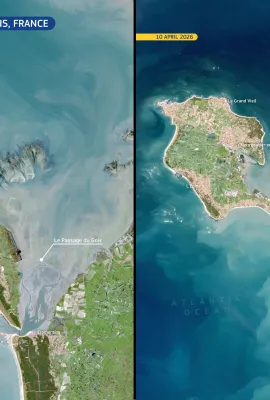
Coral reefs are the most biodiverse marine ecosystems on Earth. In addition to serving as a habitat and food resource for 25% of marine species, they provide the world with nearly EUR 2.5 billion in goods and services each year.
Results (1987)
Following the landfall of Typhoon Fung-wong on 9 November 2025, northern regions of the Philippines were affected by extensive flooding, with the Cagayan Valley among the worst hit areas. The typhoon brought intense rainfall, causing the Cagayan River to overflow its banks, submerging agricultural land, infrastructure, and urban areas,...
In October 2025, the volcanic island of Nisyros, in the south-eastern Aegean Sea, was recognised as the tenth Greek site to join the UNESCO Global Geoparks Network, reflecting its geological and environmental value. Nisyros is a dormant volcano within one of the most tectonically active zones of the eastern Mediterranean, shaped by past...
The summer of 2025 in Europe highlighted the growing impact of extreme heat. According to the Copernicus Climate Change Service (C3S) Climate Bulletins, successive heatwaves in June, July, and August pushed “feels-like” temperatures to dangerous levels in parts of the continent. These recurring events highlight a clear, data-backed...
The Pyrenees are an important ecological corridor stretching between France and Spain, connecting Atlantic and Mediterranean ecosystems across a rugged mountain landscape. The mountain range supports high-altitude grasslands, ancient forests, and glacial valleys, providing habitat for endemic species. The arrival of snow marks the beginning of...
The Copernicus Climate Change Service (C3S) has published its latest monthly Climate Bulletin, which focuses on key climate trends in October 2025. The bulletin reports that October 2025 was the third-warmest October globally, with an average surface air temperature of 15.14°C, 0.70°C above the 1991-2020 average for the month. This data...
Belém, the capital of the state of Pará in northern Brazil, lies near the mouth of the Amazon River and has grown into a key economic and logistical centre for the wider Amazon region. Located within the tropical rainforest zone, the city is the site of both urban expansion and important ecosystems. This false-colour image, acquired by one of...
The Tatra Mountains, visible in this Copernicus Sentinel-2 image, acquired on 20 October 2025, form a natural border between southern Poland and northern Slovakia, are among Central Europe’s most picturesque mountainous landscapes. The region typically receives its first snowfall in late October, whereas the surrounding areas remain snow-free...
A large plume of dust swept across the Arabian Sea in early November 2025, driven by strong north-westerly winds transporting fine particles from the arid regions of Iran and southern Pakistan. Dust storms are common in this region, in which vast dry basins and persistent winds create favourable conditions for the uplift and long-range...
In late October 2025, severe flooding struck Vietnam after days of intense rainfall. Thousands of residents evacuated their homes, with local authorities reporting at least 37 casualties. The province of Quảng Nam has been particularly affected by the impacts of the flooding. In this image, acquired by one of the Copernicus Sentinel-1...
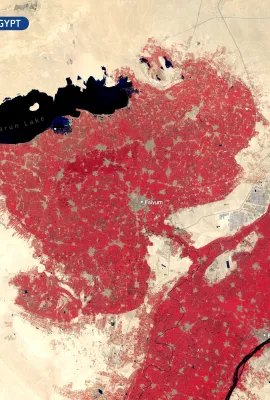
At the northeastern edge of Egypt’s Nile Delta, the Damietta branch of the Nile flows towards the Mediterranean Sea, crossing a region of significant ecological and economic importance. This area encompasses fertile agricultural land, expanding urban centres, and sensitive coastal and wetland ecosystems. This image, acquired by the Copernicus...
Across Europe, the demand for space skills is rising quickly, with new projects creating opportunities which extend well beyond engineering. From climate monitoring to digital services enabled by space-based assets, space is more than ever part of our everyday lives. This growth is also opening the door to new career opportunities for young...
Copernicus Sentinel-1D was successfully launched on 4 November 2025 at 22:02 CET (21:02 UTC) aboard an Ariane 6 rocket from the European Spaceport in Kourou, French Guiana. The satellite was released into orbit 34 minutes after launch, and the first signal was received at 23:22 CET by the Troll ground station in Antarctica. At the heart of...
The Copernicus Sentinel 1-D satellite successfully launched last night, 4 November, aboard an Ariane 6 rocket from Europe's Spaceport in Kourou, French Guiana.
Hurricane Melissa formed over the central Caribbean Sea on 22 October 2025 before moving north-west and making landfall in Jamaica as a Category 5 hurricane, the most powerful ever recorded on the island. As it continued across the Jamaica Channel, it struck the eastern coast of Cuba with sustained intensity (Category 3) before weakening over...
On 25 October 2025, the Planchón-Peteroa volcanic complex, located on the Chile–Argentina border, emitted a sustained plume of volcanic gas and fine ash that rose to approximately 600 m above the crater. The plume initially drifted north-north-west; however, shifting wind conditions during the day redirected the ash eastwards, carrying it over...
The toolkit provides a methodological framework for monitoring elements, processes and services associated to fluvial landscapes (e.g., riparian forest composition, riparian habitat connectivity, water quality) using CLMS products and complementary approaches to support decision-making in biodiversity and water resource management, restoration, and
Throughout the Cop.RIVER project, a series of national and EU-level activities were carried out engage relevant stakeholders, promote the use of Copernicus data, and develop tailored products for monitoring fluvial landscapes.
The Cop.RIVER User Uptake Session was held in mid-September 2025. The session aimed to present an overview of CLMS products contributing to the characterisation of elements and phenomena associated with riparian vegetation, river hydromorphology and the aquatic component of the fluvial landscape.
The expert workshop “Needs and Methodologies for the Characterisation of Water and Sediments in Fluvial Ecosystems”, held on September 23, 2026, brought together more than 30 participants from public organizations.
Showing 181-200 of 1987 results