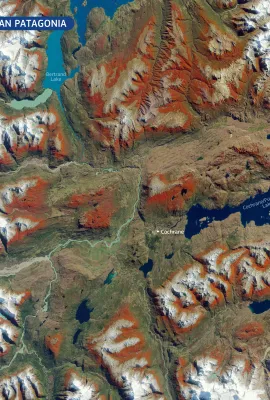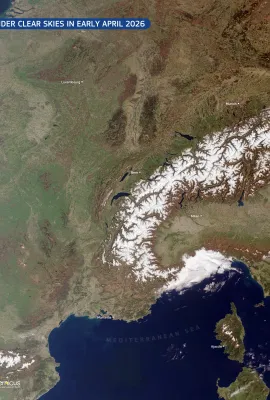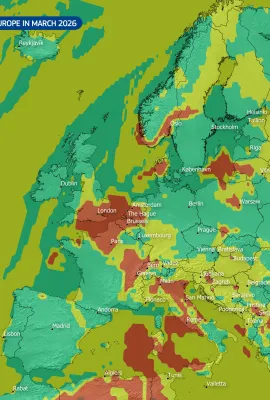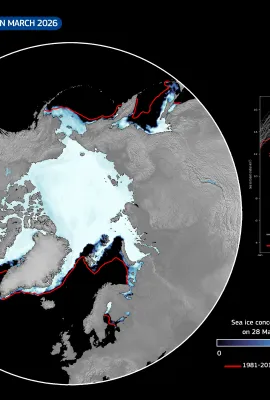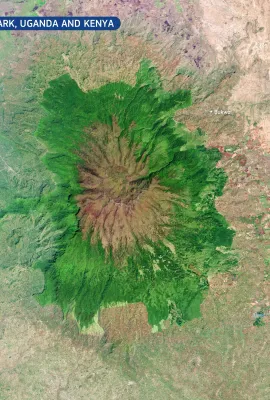
Teide National Park, a UNESCO World Heritage Site, is located on the island of Tenerife, the largest of the Spanish Canary Islands. It hosts one of the world’s most striking volcanic landscapes, with high-altitude plains, lava flows, and crater walls which host many endemic plant species and habitats. This false-colour image, acquired on 15...
Results (1080)
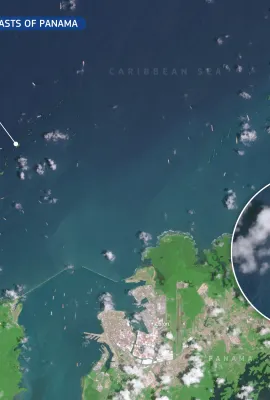
On 17 December 2025 at 06:01 CET (02:01 local time), two new Galileo satellites, designated SAT-33 and SAT-34, lifted off from Europe’s Spaceport in French Guiana. These Copernicus Sentinel-2 images show the four cities which play a central role in the EU Space Programme and Galileo, highlighting the institutional and operational...
Just weeks after its successful launch, Copernicus Sentinel-6B has delivered its first images, providing an early demonstration of how the mission will strengthen the global monitoring of oceans, coasts, and inland water bodies. Sentinel-6 is a collaborative EU–US mission, uniting the expertise of EUMETSAT, ESA, NASA, NOAA, and CNES to deliver...
Lake Omodeo, the largest artificial reservoir in central Sardinia, Italy, is a key asset for regional water supply, irrigation, and hydropower production. In recent years, however, prolonged drought conditions affecting the island have increasingly reduced its water availability, with visible impacts on the lake’s surface and storage capacity....
The Marismas Nacionales Biosphere Reserve is located in the Mexican state of Nayarit. The reserve consists of extensive mangrove systems and interconnected lagoons, including the Agua Brava lagoon and the El Chumbeño estuary, located along the Pacific coast. In addition, this protected area is the subject of initiatives to support mangrove...
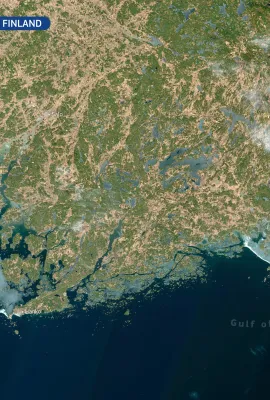
The Temmesjoki River is a small river that flows through the towns of Liminka, Tupos, and Tyrnävä on the Finnish coast of the Gulf of Bothnia, and empties into Liminganlahti Bay, a Natura 2000 and Ramsar site. This false-colour image, acquired by one of the Copernicus Sentinel-2 satellites on 28 September 2025, shows the river and its main...
On 9 December 2025, Storm Bram struck the United Kingdom and Ireland with strong winds and torrential rain, resulting in train, flight, and ferry cancellations, as well as power outages. On 10 December, flood warnings were in place across the United Kingdom, and severe flooding affected areas along multiple rivers. This image from one of the...
On International Mountain Day, we recognise the significance of mountain ranges and the crucial role that mountain regions play in the water cycle, primarily through the presence of glaciers. Glaciers are vast reserves of ice and snow distributed across the planet. They support ecosystems and communities, yet they are undergoing rapid and...
The Copernicus Climate Change Service (C3S) has published its latest monthly Climate Bulletin, which focuses on key climate trends in November 2025. The bulletin reports that November 2025 was the third-warmest November globally, with an average surface air temperature of 14.02°C, 0.65°C above the 1991-2020 average for the month. This data...
The Isle of Pines, which is part of the French overseas territory of New Caledonia, is renowned for its unique biodiversity and fragile ecosystems, including tropical forests and coastal wetlands. On 30 November 2025, a wildfire broke out on the island, spreading toward the town of Vao. The Copernicus Emergency Management Service (CEMS) was...
Graham Land, the northernmost stretch of the Antarctic Peninsula, is one of the most rapidly warming regions on Earth. Its mountainous spine and outlet glaciers drain into the Weddell Sea, forming an important transition zone between grounded ice, floating shelves, and open water. This dynamic landscape supports rich marine ecosystems,...
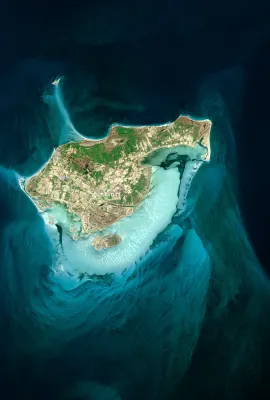
Shark Bay, located on the western coast of Australia, is a UNESCO World Heritage Site renowned for its exceptional natural beauty, including unique marine biodiversity and one of the world's most extensive seagrass beds. The site is globally significant for its ecological processes, geological formations, and as a habitat for threatened species...
The Gulf of Morbihan, part of the Natura 2000 network, forms one of France’s most distinctive coastal landscapes. This inland sea is dotted with dozens of small islands and peninsulas, creating a labyrinth of sheltered bays, narrow channels, and shifting tidal flats. Its highly indented shape supports a mosaic of coastal habitats, from eelgrass...
Early winter in north-western Africa is marked by the arrival of Atlantic weather systems that bring cooler air, increased cloud cover, and the first significant precipitation of the season. As these systems interact with the region’s varied terrain, they frequently produce episodes of heavy rain in lowland areas and snowfall across the...
The United Nations’ World Urbanisation Prospects 2025 was published on 17 November 2025. Drawing on data from the Joint Research Centre’s Global Human Settlement Layer (GHSL), developed under the Copernicus Emergency Management Service (CEMS), the report tracks changes in population distribution across more than 12,000 urban settlements. It...
Torrential rainfall associated with Cyclone Ditwah, which made landfall on Sri Lanka’s eastern coast on 28 November 2025, resulted in extensive flooding across the country. The event caused at least 410 casualties, with 336 people reported missing. The Copernicus Emergency Management Service (CEMS) was activated (EMSR851) to assess the extent...
Cyclone Senyar formed during the night of 25-26 November 2025 in the Strait of Malacca, an area in which tropical cyclones had not been recorded for decades. The day after its formation, Senyar hit Indonesia, where it made landfall, causing flooding, landslides and more than 400 casualties in the north of the island of Sumatra. This image,...
On 17 October 2025, one of the Copernicus Sentinel-2 satellites acquired this image of Cluj-Napoca, a major urban centre in north-western Romania. Surrounded by rolling hills and agricultural land, the city is noted for its dynamic growth and strategic role in regional development. Cluj-Napoca also received the label of the EU Mission for...
The Bolivian Altiplano, part of the vast Andean plateau, is among the highest inhabited regions on Earth. This arid landscape is characterised by deep canyons, colourful sedimentary formations, and rugged ridgelines shaped over millennia by wind and water erosion. This false-colour image, acquired on 1 January 2025 by one of the Copernicus...
On 16 November 2025, one of the Copernicus Sentinel-2 satellites acquired this image of the Huelva estuary in south-western Spain, where the Tinto and Odiel rivers converge before flowing into the Atlantic Ocean. Recent rainfall has increased surface runoff and sediment transport, strengthening the contrasting outflow from the two rivers. The...
Showing 101-120 of 1080 results