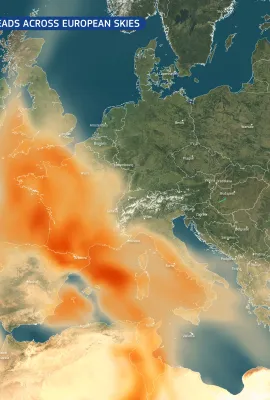
A Calima event affecting the Canary Islands in September 2025 resulted in elevated temperatures, reduced air quality, and increased health risks on the archipelago. As a result, the Spanish State Meteorological Agency (AEMET) issued an orange alert for suspended dust and high air temperatures, while wildfire alerts remained in place across the...
Results (1008)
The Gambier Islands are a small group of volcanic islands and atolls in the south-eastern part of French Polynesia, in the South Pacific Ocean. Surrounded by a large lagoon and fringing coral reefs, the Gambier Islands support rich marine biodiversity and hold significant cultural value. In June 2025, local authorities announced the...
The Fucino Plain is a geographical depression in central Italy which was once covered by a lake. It was drained in the 19th century to reclaim arable land and is now among the most intensively cultivated areas in the country. This image, acquired by one of the Copernicus Sentinel-2 satellites on 1 September, reveals a striking patchwork of...
Once the world’s largest iceberg, A23a calved from Antarctica’s Filchner–Ronne Ice Shelf in 1986. After spending decades grounded, it re-entered circulation, approaching South Georgia island at the end of 2024. After running aground in shallow waters off of the island in March 2025, it moved along the eastern flank, where it started to fragment...
The Parita Bay in Panama constitutes a key ecosystem for biodiversity and birdlife. It includes protected areas such as the Cenegón del Mangle Wildlife Refuge, Sarigua National Park, Peñón de la Honda Wildlife Refuge, and Las Macanas, one of the largest freshwater wetlands in the country. The area has been left to deteriorate over time,...
Recent heavy monsoon rains in Pakistan’s Punjab region have caused the Sutlej, Chenab, and Ravi rivers to overflow. Hundreds of thousands of people and nearly 2,000 villages have been affected by disruptions in access to electricity and clean water. This satellite image, acquired by one of the Copernicus Sentinel-2 satellites on 9 September...
In August 2025, multiple wildfires broke out along the border between Spain and Portugal, affecting natural parks and municipalities, particularly in Galicia and León. As visible in this false-colour image, acquired by one of the Copernicus Sentinel-2 satellites on 5 September 2025, the most affected areas are concentrated around the...
The Galápagos National Park, created in 1959, protects 97% of the islands’ unique wildlife, including giant tortoises and marine iguanas. A UNESCO World Heritage Site, it balances conservation with sustainable tourism and inspired Charles Darwin’s theory of evolution. This artistic impression of the Marchena Island, part of the Galapagos...
The Copernicus Climate Change Service (C3S) has published its latest monthly Climate Bulletin, focused on key climate trends in August 2025. The bulletin reports that August 2025 was the third-warmest August globally, with an average ERA5 surface air temperature of 16.60°C. This was 0.49°C above the 1991–2020 average for the month and 1.29°C...
Flowing through meandering stretches in south-eastern Austria, the Lafnitz is a dynamic lowland river where erosion and sedimentation continually reshape its middle and lower reaches. Its landscapes include sandbanks, islets, oxbow lakes, deep pools, and diverse vegetation such as gallery woods, alder–ash floodplain forests, dead timber, and...
Ballypatrick Forest, in County Antrim, Northern Ireland (United Kingdom), lies within the rugged Antrim Plateau. The landscape features conifer plantations, mainly Sitka spruce, intermixed with heathland and blanket bogs. Conservation efforts in recent years have focused on reforestation, habitat restoration, and protecting local wildlife,...
Lake Tisza, located in eastern Hungary, is the country’s second-largest lake. Spanning approximately 127 square kilometres, it is known for its diverse ecosystems and popularity for activities such as fishing, boating, and birdwatching. The surrounding wetlands serve as a habitat for numerous bird species, making it a key area for conservation...
The Étang de Montady, located in southern France near the town of Montady, is a remarkable example of medieval land reclamation. Originally a wetland, it was drained in the 13th century using a radial system of ditches converging at a central collection point. This ingenious hydraulic design transformed the area into fertile farmland and...
This Copernicus Sentinel-2 image, acquired on 5 September 2024, shows the Žuvinto, Žaltycio ir Amalvo pelkes wetland areas, a Natura 2000 site in Lithuania. Spanning an area over 18,000 hectares, this site is home to 17 EU protected bird species. The European Commission, through the LIFE Programme, is supporting the implementation of the...
Tunis, the capital of Tunisia, lies between the Mediterranean coast and a network of coastal lagoons and wetlands. The largest of these is Lake Tunis, divided into northern and southern basins, along with the smaller Sebkha Sijoumi to the south-west. Some of these wetlands are protected under the Ramsar Convention and serve as important...
Aalborg, one of Denmark’s key northern cities, lies along the Limfjord, a shallow sound connecting the North Sea to the Kattegat strait. The city blends urban development with surrounding farmland and natural waterways. This Copernicus Sentinel-2 image from 12 February 2021 highlights the path of the frozen Limfjord through the city. Urban...
Uluru, also known as Ayers Rock, is a massive sedimentary rock formation located in the heart of Australia’s Northern Territory. Rising 348 metres above the surrounding plain, Uluru is not only a striking natural landmark but also holds deep spiritual significance for the Anangu people. Estimated to be over 500 million years old, this UNESCO...
27 August is the first-ever World Lake Day, dedicated to tracking and protecting the health of millions of lakes around the globe. This Copernicus Sentinel-2 image from 13 August 2025 shows Lake Suchitlan, El Salvador’s largest wetland reservoir and a key source of the country’s hydropower. In the image, the green colouring on the lake’s...
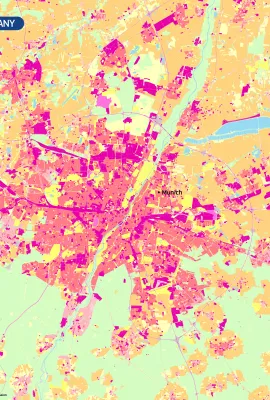
The Copernicus Emergency Management Service Global Human Settlement Layer (GHSL) provides detailed mapping of human presence around the world. This data enables urban planners, researchers, and policymakers to assess demographic distribution, infrastructure needs, and urban expansion trends, supporting informed decisions for sustainable city...
Amorgos, the easternmost island of the Cyclades, seems to guard the nearby Small Cyclades with its oblong shape. It stands at the centre of the Southern Aegean Sea, acting as a crossroads where the North meets the South. Rising dramatically above the sea, parts of Amorgos offer sweeping ocean views. This striking Cycladic Island features...
Showing 121-140 of 1008 results