Greenish Sea Ice in the Cooperation Sea, Eastern Antarctica
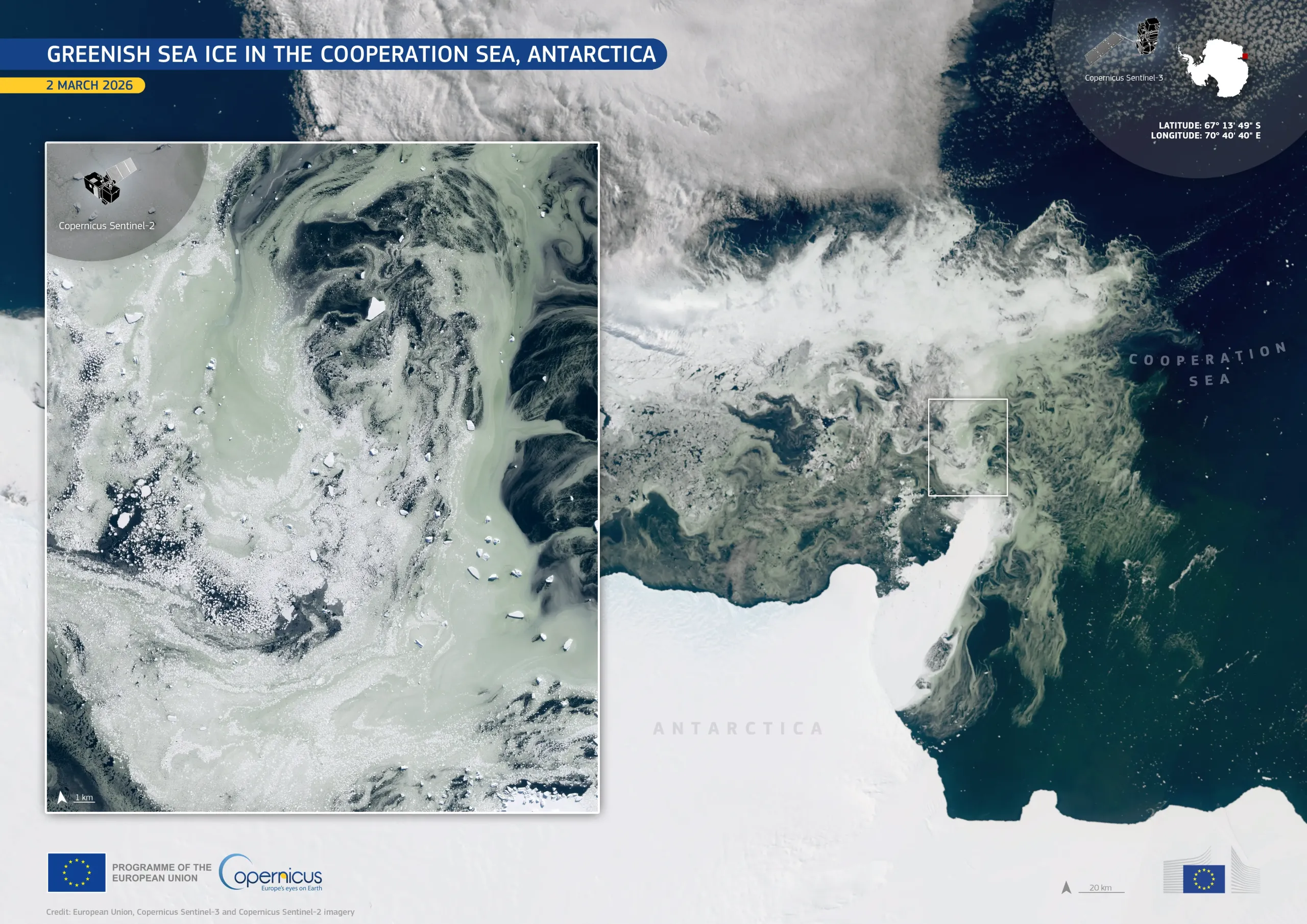
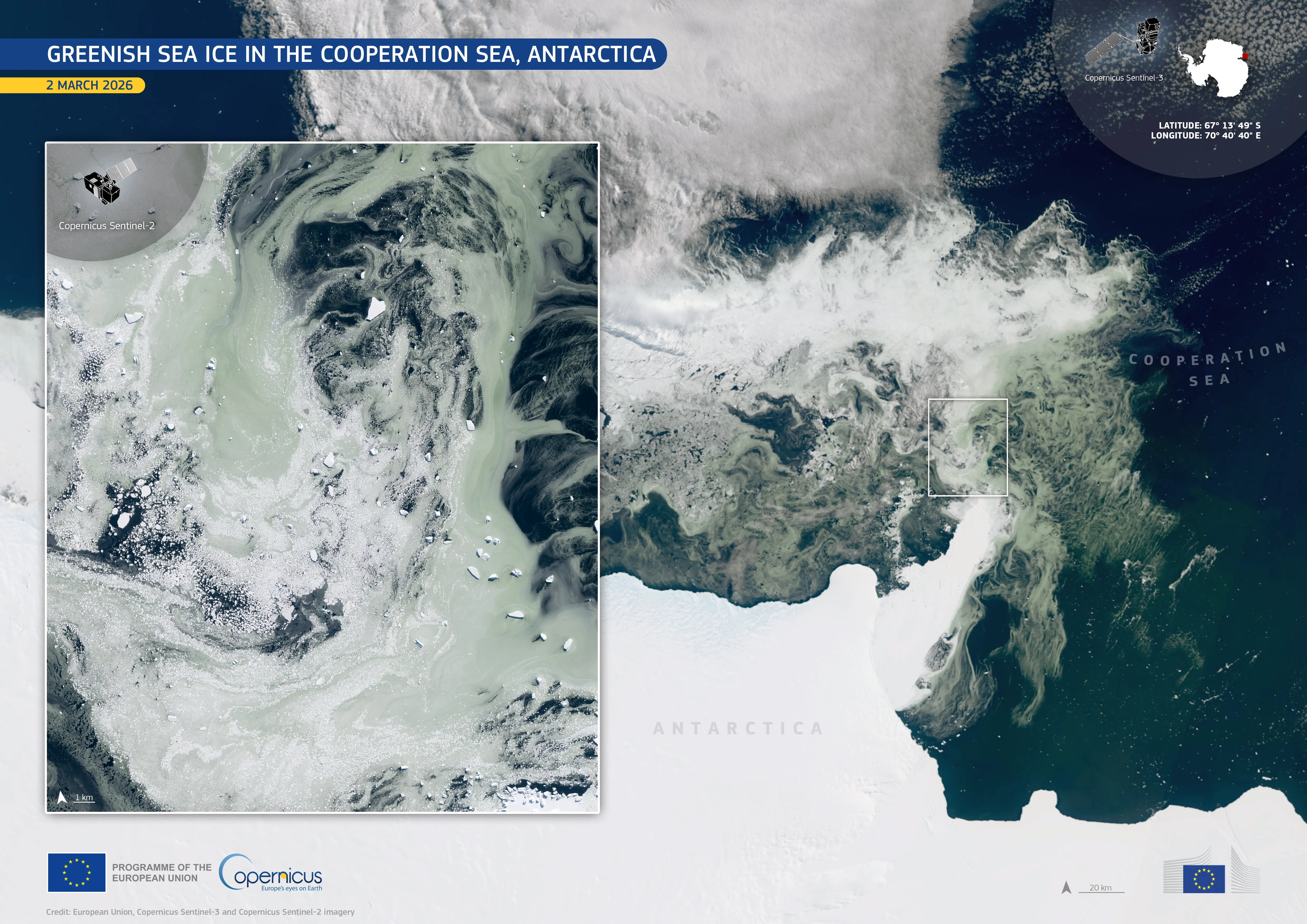
Seasonal phytoplankton blooms are an important component of the life cycle of marine ecosystems. In the seas surrounding Antarctica, these blooms develop when sunlight returns at the end of the austral night and melting sea ice releases nutrients into surface waters. High concentrations of phytoplankton can give the water a greenish colour, which is sometimes visible between drifting sea ice fragments.
This scene shows part of the Cooperation Sea along the eastern coast of Antarctica. The broad view, acquired by one of the Copernicus Sentinel-3 satellites on 2 March 2026, highlights a large patch of green-tinted waters spreading through the ice pack. The inset, acquired on the same day by one of the Copernicus Sentinel-2 satellites, reveals the finer structure of the phenomenon: pale green streaks and filaments weaving between individual sea-ice fragments, tracing the flow of phytoplankton-rich waters at the ocean surface.
Copernicus satellite data support the detection and monitoring of phytoplankton blooms across remote polar oceans. These observations help researchers better understand austral marine ecosystems and assess how they respond to environmental change.